Every Distance Is a Delay
Light crosses the room instantly and the galaxy in 100,000 years. Why the speed of light is slow at cosmic scale, and what that says about the human ruler.
The speed of light is exactly 299,792,458 metres per second. At human scale that is instant: the lamp comes on and the room is lit. Nobody has ever noticed a delay.
Scale up and the same number turns into a sentence about time.
The same speed, longer rulers
Earth’s mean orbital distance is 149.598 million km. Divide by the speed of light:
\[\frac{1.49598\times10^{8}\ \text{km}}{2.99792\times10^{5}\ \text{km/s}} \approx 499\ \text{s}\]So the Sun you see is about 8 minutes and 19 seconds old. The nearest other star, Proxima Centauri, is 4.25 light-years away, so a message to it takes four years one way, and a question with its answer takes more than eight.
The Milky Way is about 100,000 light-years across, so light needs roughly 100,000 years to cross our own galaxy. The Andromeda galaxy, the nearest major galaxy, is 2.5 million light-years away. Anyone looking at us from there sees Earth as it was 2.5 million years ago, and a reply to a signal sent today would arrive 5 million years later.
Every distance is a delay. To look far is to look back, and no telescope can show a present that is not also the past.
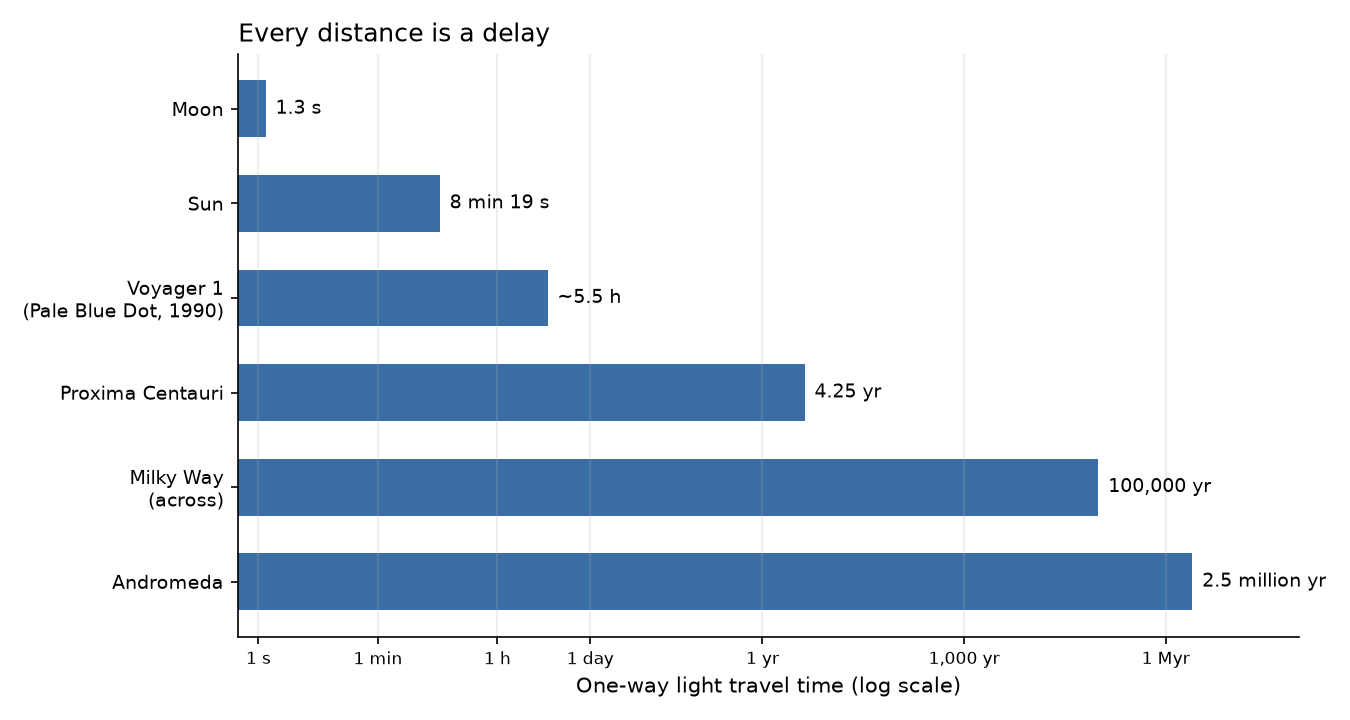 One-way light travel time on a log scale. Distances from the NASA sources above; Voyager 1 at about 6 billion km on 14 February 1990 (NASA).
The nearest big neighbour looks like this. NASA describes this Hubble composite as resolving individual stars across a 61,000-light-year section of Andromeda’s disk, and every one of them is shown as it was about 2.5 million years ago.
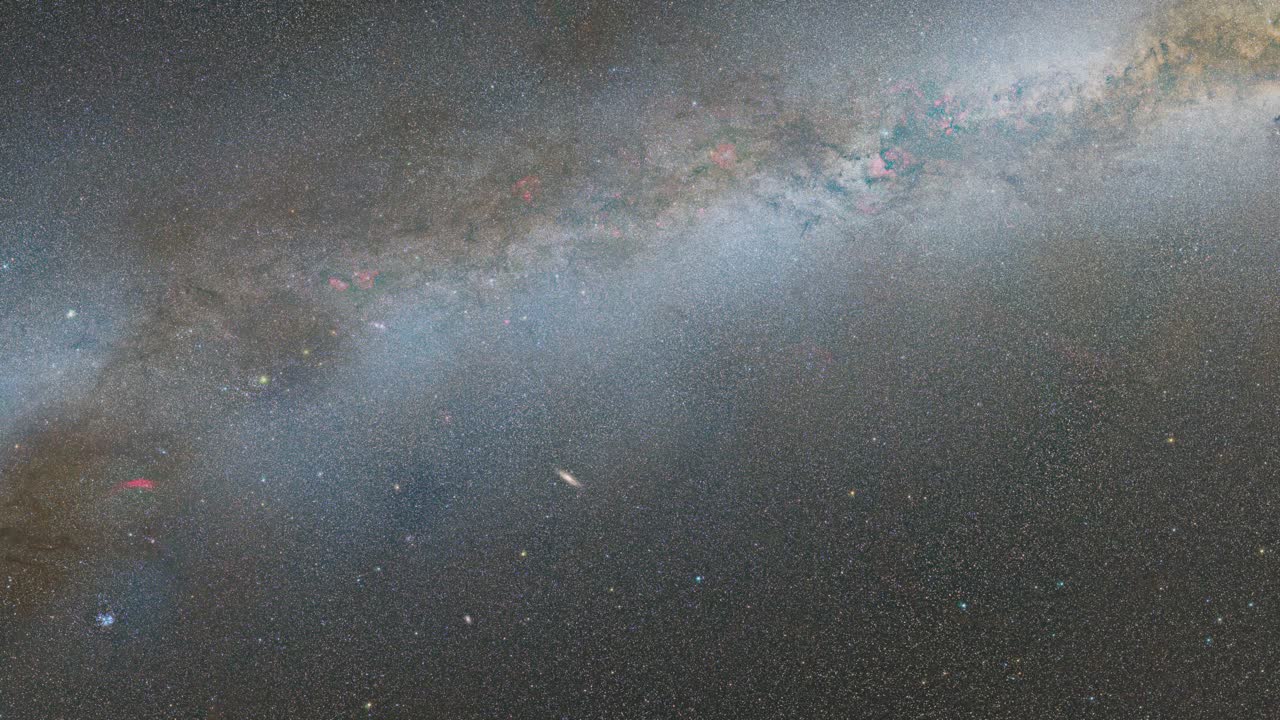 Andromeda galaxy (M31), Hubble Space Telescope panorama. Credit: NASA Goddard (NASA Image and Video Library).
Nothing is standing still
The usual picture of the cosmos is a stage with fixed seats. The numbers say otherwise.
Earth does not hover above the Sun. It moves at a mean orbital velocity of 29.78 km/s, sideways relative to the Sun’s pull. Gravity bends that straight line into a loop, so the planet is falling toward the Sun continuously and continuously missing it. That is the old cannonball argument: fire fast enough and the ground curves away as fast as you fall.
The Sun is moving as well. NASA gives an average velocity of 450,000 miles per hour (about 720,000 km/h) around the centre of the Milky Way, and one lap takes about 230 million years. No inertial frame is privileged: “at rest” only means “at rest relative to something chosen for convenience.”
The edge is not where it looks
NASA’s astrophysicists estimate the observable universe at about 92 billion light-years across, larger than the 13.8 billion years of light travel time because space expanded while the light was in transit. That number is a limit on what can be seen, and it says nothing about where the universe ends. What lies beyond is simply outside the data.
The practical consequence is humbling. A signal sent at light speed to a sufficiently distant region may never arrive, because the space between us keeps stretching. Visible is not the same as reachable.
What a ruler is for
A ruler is calibrated for the thing it measures. A person is built for metres and seconds, and within that range “fast” and “slow” mean something. Carry the same words to the Milky Way and they stop working: light, the fastest thing there is, becomes a slow messenger, and a civilization could rise and fall while a greeting is still on its way.
The mistake is not in the universe being too big. The mistake is calling the universe slow or empty with a unit that was never made for it. Fast, slow, near and far are all statements about a ruler, and the ruler has to change when the scale does.