How to Speak: Patrick Winston's Hour, Section by Section
A full walkthrough of Patrick Winston's MIT lecture How to Speak, in his order: how to start, tools, informing, persuading, getting remembered and how to stop, with what cognitive-load research and LLM papers add.
Patrick Winston, who directed MIT’s AI Laboratory from 1972 to 1997, gave a talk called How to Speak every January for more than forty years. The recording is an hour long and densely packed: a formula, four verbal habits, rules for rooms, boards, props and slides, three kinds of high-stakes talk, a five-letter recipe for being remembered, and a way to end. This post walks through all of it in his order, so the hour does not need to be watched twice. Where he states a number or a claim without a source, it is reported as his. The last two sections are not his: they set his rules beside research on human attention and on language models.
Why it matters: knowledge, practice, talent
He opens with the Uniform Code of Military Justice, which specifies court martial for any officer who sends a soldier into battle without a weapon. Students, he says, deserve a similar protection, because they should not go out into life without the ability to communicate. His reason: “your success in life will be determined largely by your ability to speak, your ability to write, and the quality of your ideas, in that order.”
The quality of communication, he says, follows from three things: how much knowledge you have, how much you practice with it, and your inherent talent. In his notation these are K, P and T, and “the T is very small.” What matters is what you know. His proof is a ski slope at Sun Valley, where he found himself skiing better than an Olympic gymnast who was a novice on skis: “I had the K and I had the P and all she had was the T.”
The promise follows. Among the examples in the hour, one, perhaps only one, will be the technique that gets you the job. He calls this a very nonlinear process: you never know which one it will be, so the aim is to put several in your repertoire.
Then one rule of engagement: no laptops, no phones. His reason is the idea the rest of the talk keeps returning to: “we humans only have one language processor.” If yours is busy with email, you are distracted, and so is everyone who can see your screen.
How to start
Most people open with a joke. He advises against it. At the start people are still putting their laptops away and adjusting to your voice, and a joke falls flat.
Open with what he calls an empowerment promise: tell the audience what they will know at the end of the hour that they did not know at the beginning. His own example: by the end of this hour you will know things about speaking you do not know now, and something among them will make a difference in your life. It is the reason for being in the room, stated up front.
Four habits to keep in mind
He gives four “tics” that are always on his mind when he speaks, and presents them as samples from a larger repertoire.
Cycle. Go around the subject, then go around it again, then again. People sometimes say: tell them what you will tell them, tell them, then tell them what you told them. He gives the reason: “at any given moment about 20% of you will be fogged out no matter what the lecture is,” so to make the probability that everyone gets it high, say it three times.
Build a fence. When explaining an idea, separate it from the neighbouring ideas people might confuse it with. Teaching an arch to someone from Mars, he says what an arch is, then shows what is not an arch. In technical talks: my algorithm may look like Jones’s algorithm, except his is exponential and mine is linear.
Verbal punctuation. Because people drop out and need to get back on the bus, give them landmarks. He enumerates: this is the outline, first we do this, among the four samples the first is cycling, the second is building a fence, now the third. Numbers announce a seam in the talk where anyone can rejoin.
Ask a question. A question also brings people back. How long can you wait for an answer? “I counted 7 seconds,” which feels like an eternity, but that is the standard time to wait. The question must be chosen with care: too obvious, and people are embarrassed to answer; too hard, and nobody has anything to say.
His general advice follows: watch speakers you admire, ask why they are effective, and build your own personal repertoire and style from that.
Time and place
When. 11:00 a.m. is a good time for a lecture: most people at MIT are awake by then, hardly anyone is going back to sleep, and it is not right after a meal.
Light. The room should be well lit. When the room is dim, it signals that we should go to sleep. He tells audiovisual staff to keep the lights full up. If they say people will see the slides better with the lights off, he replies that it is “extremely hard to see slides through closed eyelids.”
Case the place. Do it as if you were robbing a bank: go to the room beforehand so there are no surprises. He asks his host to take him to the room first and says what he does on arrival: imagine all the seats are filled with disinterested farm animals, so that however bad it is, it cannot be worse than that.
Fill the room. It should be more than half full. If ten people sit in a large hall, everyone wonders what is going on, and that is more interesting than anything you say. A room that is right-sized does not have to be packed.
Boards, props and slides
He says the right tool depends on purpose. The board suits informing: teaching and lecturing. Slides suit exposing, which is what you do in a job talk or conference talk: you expose ideas, you do not teach them.
The board. It has three properties he likes. It has a graphic quality: you can draw. It has the right speed: the pace at which you write is about the pace at which people can absorb ideas, whereas nobody can follow a flick through slides. And it is a target for your hands. Novices become suddenly aware of their hands, as if they were private parts, and put them in their pockets or behind their backs. In some cultures that is insulting; he tells of a nun in a Serbian convent who pulled his hands from behind his back. His explanation: hands out of sight look like a concealed weapon. With a board you have something to do with them: point. He once watched Seymour Papert lecture twice, first for content and then for style, and noticed that Papert constantly pointed at the board, at things unrelated to what he was saying. It worked anyway.
Props. Playwrights, he says, are the custodians of knowledge about props. He recalls an Ibsen play, Hedda Gabler, in which a woman in an unhappy marriage watches her husband compete for an academic job against a rival who has just written a magnificent book, in the days before copying machines. As he remembers it, the stage has a pot-bellied stove with its door open and slightly glowing embers, and as tension mounts the fire grows hotter, until you just know the manuscript is going into the fire. The prop did the work of foreshadowing, and it is what he remembers of the play. (As he remembers it: Ibsen’s stage directions, in the Gosse and Archer translation, call for “a wide stove of dark porcelain” in the first act, open the third act with the stove door open and a fire “nearly burnt out,” and have Hedda burn Eilert Lovborg’s manuscript there. The stove and the burning are as he says. The fire growing across the play is his memory of the staging, not Ibsen’s text.)
Props are not only for playwrights. His second example is a spinning bicycle wheel with torque applied to the axle: which way does it go? Mechanical engineers, he says, remember the right-hand rule but not how to align their fingers, so they get it right with about 50% probability, no better than a coin. The better way is to put duct tape on one part of the wheel and think about that piece only: it comes over the top, you blow on it, it goes down, and so does the next piece. Think about the problem the right way and you never wonder again. A third prop: a heavy steel ball on a long wire, released from his nose against a wall, which swings across the room and gently kisses his nose on the way back, because he believes in the conservation of energy. He adds: do not try this at home, since the natural tendency is to push.
Why do props and boards work? Surveys always say students want more chalk and less PowerPoint. His own explanation, which he calls his “lunatic fringe view,” is empathetic mirroring: watching you write on the board, the mirror neurons in your head activate and you feel yourself writing, and watching the ball swing you feel the ball. You cannot do that with a slide or a picture. He admits speed is also involved.
Slides. A slide, in his experience, always has too many words and talks always have too many slides. He tells of meeting a stranger at Logan airport, on his way to Europe to give a job talk, who asked him to critique his slides: “you have too many, and they have too many words.” He then demonstrates the crimes while committing them:
- Reading your slides. The audience can read, and it annoys them.
- Many words per slide. We have one language processor: we can use it to read or to listen, not both. A former student’s experiment taught students some web programming ideas, half on slides and half spoken, with the halves swapped for a control group. They remembered what they read better than what they heard. One subject said afterward: “I wish you hadn’t talked so much, it was distracting.”
- Standing far from the slide, so the audience watches a tennis match between speaker and slide.
- Background clutter, logos, a title that repeats the talk. Remove them and you can say what is no longer written, without reading.
- Small fonts. Microsoft allowed too small a size, so he tells people to keep a sample slide to find the minimum. He asked a student: 40 or 50 point, he says, is about right; 35 is too small, not because it cannot be read but because it lets you put too many words on the slide.
- The laser pointer. The old wooden pointers got waved around, and he once recommended breaking one at the end of a talk. The laser pointer is worse: to use it you turn your back and point, which means “no eye contact, no engagement, nothing.” A student sitting next to him said that everyone could leave and he would not know. Instead, put a small arrow with a number on the slide and say: look at number one.
- Heavy slides. When asked to review a presentation, he has people print it and lay it out on a table. Then you can see whether it has too much text, not enough white space and not enough imagery. His own example of a talk with air in it is mostly pictures, with three or four text slides, and when one comes he gives the audience time to read it. One of them is a historical excerpt, from the Dartmouth proposal that started AI in 1957. A slide of overwhelming complexity, for example one that shows how impossibly complicated governing Afghanistan is, can be used once per presentation. He gives a limit: one per talk, one per paper, one per book.
He closes the section with a gallery of crimes he has seen: hands in pockets; a poor choice of room (a dark, hard-to-find theatre at the Media Lab, which he says is a place for watching a movie, not for giving a talk); and a real talk where the speaker stood far from the slides, used a laser pointer, and was on slide 80 with the first of ten conclusion slides. The meeting’s sponsor was reading email, the co-sponsor was studying the lunch menu, and one man looked attentive, though a video would have shown otherwise.
Informing: promise, passion and the stories we think with
For a talk whose job is to inform, he repeats the opening move: start with a promise. Then express passion.
When the department chair asked him to talk to new faculty about inspiring students, he had not thought about it before, so he surveyed incoming freshmen, senior faculty and people in between about how they had been inspired. Freshmen were inspired by a high school teacher who told them they could do it. Senior faculty were inspired by someone who helped them see a problem in a new way. Everyone was inspired by someone who showed passion about what they were doing. He finds it easy: “if you’re not interested in artificial intelligence, you’re probably not interested in interesting things.”
His example is a resource allocation lecture that opens with a program colouring a map of the United States so that no two bordering states share a colour. He lets the first version run and does not wait for it to finish, “because the sun will have exploded and consumed the Earth.” With a slight adjustment, which students will understand within 50 minutes, it finishes in a few seconds. “Isn’t that cool?” The point is to promise something up front and show how much you value it.
On teaching people how to think, a goal every faculty member states and nobody can explain, he offers a theory. We are storytelling animals: we develop story understanding and manipulation from fairy tales in childhood, and continue through law, business, medicine and engineering. So to teach thinking, provide the stories people need to know, the questions to ask about them, mechanisms for analysing them, ways of putting stories together, and ways of judging how reliable a story is.
Persuading: oral exams, job talks, and getting remembered
Oral exams
The usual reasons for failure, he says, are a failure to situate and a failure to practise. To situate is to put your research in context: this problem is pursued all over the world, nothing has moved in thirty years, a solution would have impact on many other things. Practise, but not in front of the people who share your office, and not with your supervisor. Anyone who knows what you are doing will hallucinate that there is material in your presentation that is not there. Rehearse for friends who do not know your work, and start the practice session with: “if you can’t make me cry, I won’t value you as a friend.”
As for the committee, he says that the amount of flak you get is proportional to the questioner’s age: the older people are, the better they understand where they are in the world, while the young are trying to show the old how smart they are. A committee full of grey hair is what you want.
Job talks
He asked two colleagues on the Navy Science Board what they look for in a faculty candidate. Within a microsecond, one said the candidate has to show some vision, and the other said they must show they have done something. How long do they have to establish both? Five minutes. If you have not expressed a vision and shown you have done something in five minutes, you have lost.
Vision is a problem someone cares about plus something new in your approach. His own: understanding the nature of human intelligence, approached by asking what makes us different from chimpanzees and Neanderthals. His answer is that we are symbolic creatures: we can build symbolic descriptions of relations and events, string them into stories, and the stories are what set us apart.
Having done something is shown by listing the steps needed to realise the vision. You do not need to have done every step, but say what needs doing. His example: specify the behaviour, enumerate the constraints that make the behaviour tractable, and implement a system, “because we’re engineers and we don’t think that we’ve understood something unless we can build it.” Then say you have built such a system and will demonstrate it. You end by enumerating your contributions, which mirror the steps.
Getting famous
Why care? He tells of sitting at a fundraiser for saving Venice next to Julia Child, who was approached all evening by people wanting an autograph. He asked if it is fun to be famous. She said you get used to it, “but you know what occurred to me, you never get used to being ignored.” His own version: your ideas are like your children, and you do not want them going into the world in rags. So packaging is a legitimate concern.
To be remembered he offers what he calls the Winston Star, five items that each begin with S. His example is his own 1970 PhD work on arch learning, which became mildly famous, and he realised only years later that it had all five.
- Symbol. Something visual attached to the work. Here, the arch itself.
- Slogan. A phrase that gives a handle on the work: “one-shot learning,” because the program learned something definite from every example. Going from an arch to something that is not an arch, it learned that one block must be on top.
- Surprise. You do not need a million examples to learn; one is enough if you are smart about using it.
- Salient idea. Not “important” but “sticking out,” something that protrudes. Some theses have too many good ideas, and you cannot tell what they are about. The salient idea here was the near miss: a structure that is not an arch but misses by very little.
- Story. Tell how you did it, how it works and why it matters.
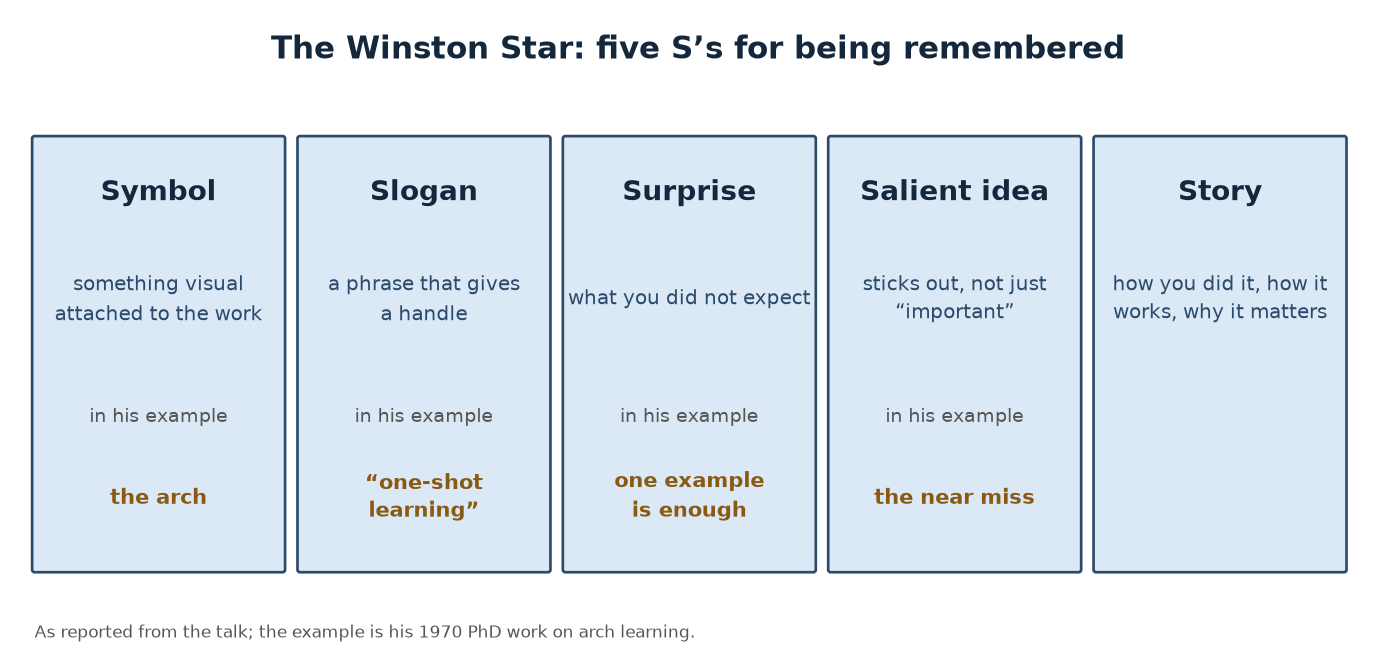 Figure 1. The five S’s, with the example he gives from his 1970 PhD work.
How to stop
His last topic is the ending: the final slide and the final words.
The final slide. He goes through what not to put there, because each wastes the last image the audience will see.
- A long list of collaborators. With a thousand faculty at MIT, a gigantic list suggests that nobody can tell whether you did anything significant. Credit collaborators on the first slide, where it belongs.
- A slide that can stay on screen for twenty minutes while people ask questions. He calls it the worst possible way to end, because it squanders the chance to tell people who you are.
- A “Conclusions” slide. They are perfectly legitimate conclusions, but nobody cares about them. What people care about is what you have done.
So the final slide is labelled Contributions, the one that stays up while people ask questions and file out. His own is a stump speech: here are the things I typically demonstrate, with a pause for people to read it, and a last line that says what we get out of it. (The next section expands on how to write one.)
The final words.
- A joke is acceptable at the end, when people have adjusted to your voice. He was told by Doug Lenat, a speaker he calls fantastic: “I always finish with a joke, and that way people think they’ve had fun the whole time.”
- “Thank you” is a weak move. It will not send you to hell, but “thank you for listening” suggests that everyone stayed out of politeness and wanted to be elsewhere. Once applause has begun you may mouth thanks; just do not make it the last thing.
- Political speeches show how to end without it. He plays the ends of two U.S. convention keynotes, by Governor Christie (“God bless you and God bless America”) and Bill Clinton, whom he describes as pressing his lips together as if forcing himself not to say thank you, then giving a small salute.
- Other cultures use stock closings. The Latin Mass ends with Ite, missa est, which he glosses as “okay, the Mass is over, you can go home.” At a concert the audience claps when the conductor shakes hands with the concertmaster.
- The last option is to salute the audience: say how much you value your time and place. He ends the hour that way: he is glad they came, because by being there they showed they understand that how you present and package your ideas matters, and he salutes them for it. “Come back again and bring your friends.”
Putting contributions on the final slide
Winston’s own model of the final slide is short: a heading, Contributions, a few lines, and room to read. His rules, taken from the hour:
- It is the last slide, and it stays up through questions, so it must be worth looking at for as long as it is there.
- It mirrors the steps from the middle of the talk. If the talk said “specify the behaviour, enumerate the constraints, implement a system,” the contributions are the same things as achievements: the behaviour you specified, the constraints you identified, the system you built.
- It is about what you have done, not what you concluded or whom you thank. Conclusions are legitimate, he says, but nobody cares about them.
- You give people time to read it. He says that when he shows it, he waits.
- The last line says what we get out of it: the payoff for the listener.
What follows are my own additions, not his; they are a way to apply his rule:
- Phrase each line as something that exists after the work: a result, a method, a system, a dataset, a finding. A line that begins “I looked at” or “we discussed” describes activity; one that begins “a method that” or “evidence that” is a contribution.
- Three to five lines is enough. Each line is something a listener could repeat to someone else tomorrow.
- A useful check is whether a stranger could cite the line. If not, it is probably a topic rather than a contribution.
- Put the specifics near the top of the line (numbers, scale, what it beats), and the payoff in the last line, so the slide works as the thing people remember.
What research adds: the one-channel claim
Winston’s “one language processor” is his phrase, not a research term, but it has a counterpart in the literature. Richard Mayer and Roxana Moreno’s Nine Ways to Reduce Cognitive Load in Multimedia Learning assumes that people have separate channels for verbal and visual material, and that each has limited capacity. From that they derive a redundancy effect: students learned better from an animation with narration than from an animation with narration and on-screen text, with a median effect size of 0.69 across three studies. That is a close match to his slide rule: words on the slide compete with words in your mouth.
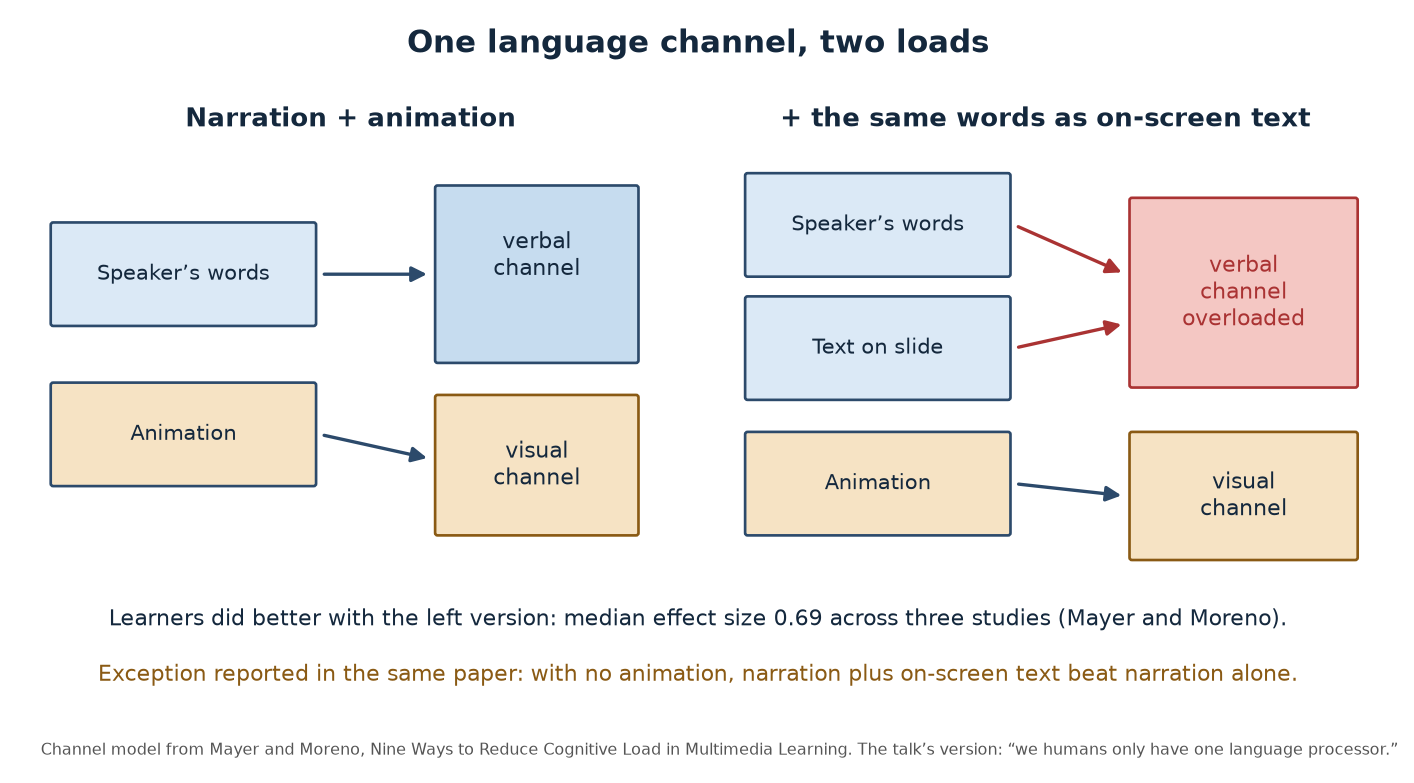 Figure 2. The channel model behind the redundancy effect, with the exception reported in the same paper.
It is not the whole picture. The same paper reports that when there is no animation, narration plus on-screen text did better than narration alone (Moreno and Mayer, 2002, experiments 1 and 3). The reading of this that fits Winston: the rule bites when the slide already has something to look at, or when the text is long and competes with the speaker. A single key phrase on a quiet slide may help.
A neighbouring result comes from Pashler’s 1994 review of dual-task interference: people have trouble performing two simple tasks at once, because of a bottleneck in choosing actions and in memory retrieval. That is about reaction-time tasks, not about reading and listening, so it points in the same direction as Winston without confirming his claim.
The same constraint in a language model
A speaker who overloads the audience, and a prompt that overloads a model, fail in similar ways. This section is my own analogy, offered with the limits stated.
Position matters. Winston’s advice to start with a promise and end with contributions puts the most important things at the two ends of the talk. Lost in the Middle found that language models do best when the relevant information is at the beginning or end of the input, and degrade significantly when it sits in the middle, even for models built for long contexts. Different mechanism, same shape: the ends of a sequence are privileged.
Clutter costs accuracy. His rule against background junk and extra words has a counterpart in Large Language Models Can Be Easily Distracted by Irrelevant Context, where adding irrelevant information to a problem dramatically lowers accuracy on grade-school maths, and an instruction to ignore the irrelevant material helps. In a model’s case you can say “ignore this.” A listener cannot, which makes the speaker’s job harder.
One example can be enough. His slogan “one-shot learning” described a symbolic program that learned something definite from each example, with near misses doing most of the teaching. Language Models are Few-Shot Learners shows that a large model can perform a new task from a few examples placed in its prompt. The mechanisms are unrelated, since his program changed its internal description and the language model does not update its weights, so the shared name is a coincidence. What carries over is the lesson that a well-chosen example, especially a near miss, teaches more than many arbitrary ones.
A limit on the analogy. A speaker’s listeners drift in and out; a model processes its whole input with attention at once. Winston’s cycle, fence and verbal punctuation are repairs for lapses of attention that models do not have in the same form, and I know of no study showing that repetition or numbered landmarks help a model the way they help people. These habits are about people, and the analogy stops there.
The principle
Every rule in the hour spends or saves the same thing: the listener’s limited ability to take in language. Lights up, fewer words, a pointer that does not turn your back, a promise at the start, an enumeration in the middle, a contributions slide at the end: each is a way of making sure the listener’s capacity is used on the idea and not on the delivery. The speaker’s task is to design the talk around that budget, and the budget is the same whether the listener is a person at 11:00 a.m. or a model reading a long prompt.