Small Is a Scale, Not a Value
From Earth as a pixel to a civilization as a few centimetres of rock: why smallness describes a scale, and why the same distance that shrinks everything also makes one place matter.
On February 14, 1990, Voyager 1 turned its camera around from 6 billion kilometres out and photographed Earth. In the frame the planet is a fraction of a pixel, a pale dot caught in a band of scattered sunlight. Carl Sagan, who had pushed for the picture, later wrote of it in Pale Blue Dot: “That’s here. That’s home. That’s us. On it everyone you love, everyone you know, everyone you ever heard of, every human being who ever was, lived out their lives… on a mote of dust suspended in a sunbeam.”
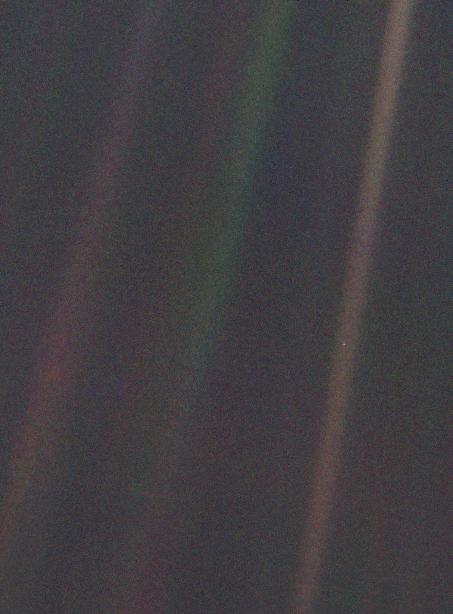 Pale Blue Dot, Voyager 1, 14 February 1990. Earth is the speck in the right-hand light band. NASA describes it as a crescent only 0.12 pixel in size. Credit: NASA/JPL.
The usual reading is deflation. If everything that ever happened fits inside one pixel, nothing in it can matter much. That reading sneaks in an assumption: that importance is proportional to size. The rest of this post tests the assumption.
Distance changes the picture, not the thing
Pull the camera back and every human fact shrinks together: wars, borders, fortunes, the number of people alive. The shrinking is a property of the viewpoint. Nothing in the dot got smaller, and no event in it became less real. A map at 1:10,000,000 shows a city as a smear, and the people in the city are not smeared.
The same applies to time. Compare the human footprint with geological time.
A civilization as a few centimetres
In 2018 the astrophysicist Adam Frank and the climate scientist Gavin Schmidt asked a thought-experiment question in the International Journal of Astrobiology: if an industrial civilization had existed millions of years ago, would we be able to detect it today? Their answer is sobering about fossils. For all the dinosaurs that ever lived there are only “a few thousand near-complete specimens”, and a species as short-lived as Homo sapiens might not appear in the fossil record at all. About the human era itself they say that, in ocean sediment cores with multi-million-year-old layers, the Anthropocene “will likely only appear as a section a few cm thick.”
They also note that direct artefacts are the wrong thing to look for. The better signals are chemical: isotope anomalies from burning fossil carbon, rapid warming events like the Paleocene-Eocene Thermal Maximum about 55 million years ago, and isotopes such as plutonium-244 that nature does not produce outside a supernova.
The paper is a thought experiment, not a discovery. Frank and Schmidt told CNN that neither believes the hypothesis, only that it cannot be ruled out yet. The geologist Jan Zalasiewicz, co-author of the 2025 book Discarded on technofossils, argues they underestimate how much a civilization like ours leaves behind: cities, smelted metals and plastics make “a clear footprint”. He is comfortable ruling out a prior civilization of our kind, while allowing for quieter ones, “dinosaurs that could sing complex arias, say, or Jurassic ammonites that could compose poetry.”
Both sides agree on the structure of the problem. A thin layer of rock is a lossy record of a long story. The record being thin says something about rock and nothing about the story.
What people report when they see the dot from close
The astronauts who see Earth whole, not as a dot but as a lit sphere with a visible edge of atmosphere, often report the opposite of deflation. The writer Frank White interviewed many of them and coined the term overview effect in his 1987 book The Overview Effect: Space Exploration and Human Evolution. Reports vary, from the spiritual to the plainly naturalistic, but share a theme: the planet looks fragile and borders do not appear.
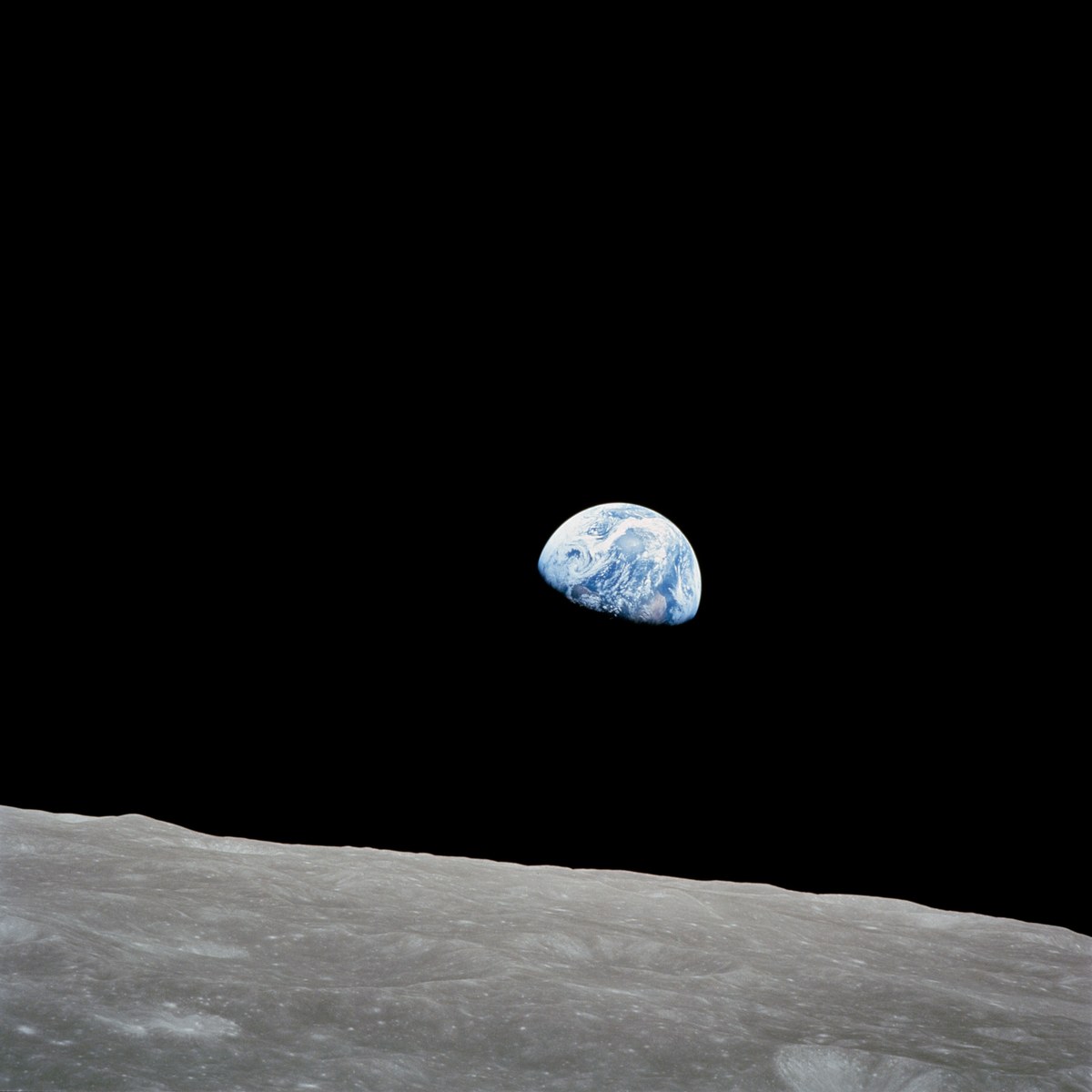 Earthrise, Apollo 8, 24 December 1968. Credit: NASA. Taken by Bill Anders (Wikipedia).
The clearest single sentence comes from Bill Anders, who took the Earthrise photograph on Apollo 8 in 1968. Fifty years later, he said: “We set out to explore the moon and instead discovered the Earth.” The trip was about the Moon. The thing that changed people was the view back.
Two caveats keep this honest. The overview effect is self-reported, and White’s own claim is that it needs experience to understand, which makes it hard to test. And what astronauts feel on a lit sphere is not what Sagan writes about a pixel. The common ground is the move from inside to outside.
Small, rare, and the only one
Put the three pictures together:
- At the scale of the Milky Way, Earth is invisible.
- At the scale of geological time, a civilization is a thin line in rock.
- At the scale of one person looking at the planet whole, the planet is the only inhabited place they know of.
Size, duration and importance are three different axes. A star can burn for ten billion years and affect nothing alive. A conversation can last a minute and change a life. The universe measures distance, mass and time, and has no unit for mattering, so any unit we use to say “this matters” comes from us, from what we love and who is in the frame.
That is not a consolation prize. It is the plain reading of the data. Nothing in Voyager’s image says the dot is unimportant, because importance is not a quantity a camera records. What the image does say is that there is one dot with everyone in it, and that anything done to it is done to all of them.
Smallness is where we stand. What counts is decided by what we choose to look after from there.