The Learning Path Landscape for LLMs — A Map of Where to Go at Each Stage
A stage-by-stage map of the best resources for learning LLMs, from foundational math to research-level papers.
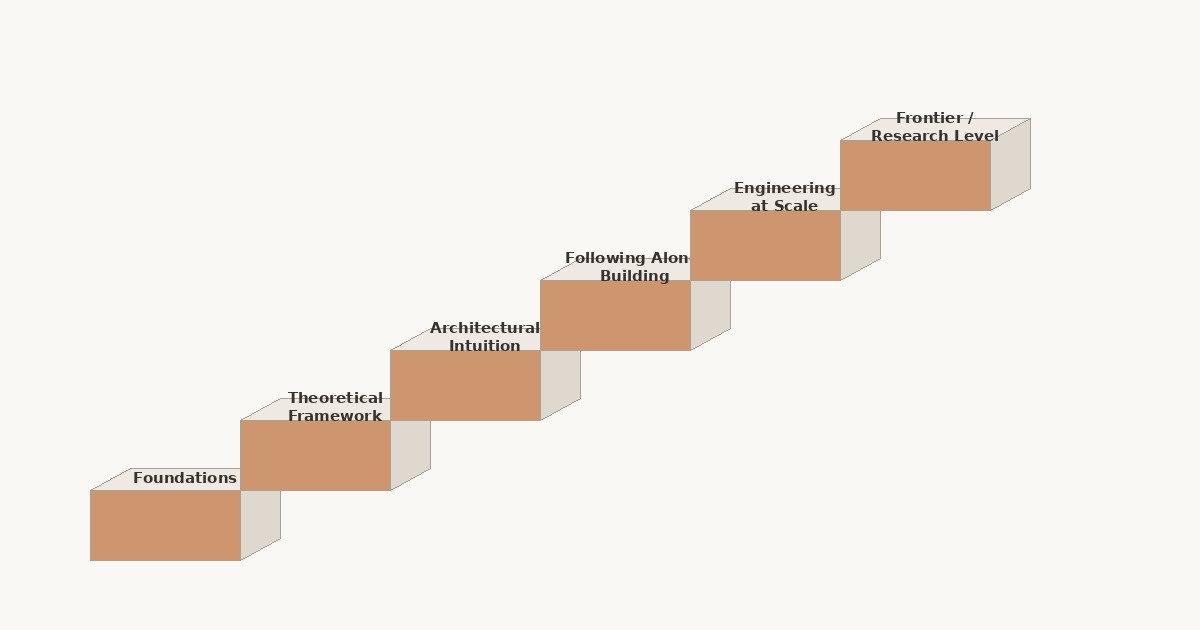
Learning large language models isn’t one long staircase — it’s a series of distinct stages, each with its own state of mind and its own best resources. Here’s a map of that path.
| Stage | Learner’s State | Representative Solutions |
|---|---|---|
| Foundations | Needs Python, linear algebra, calculus, statistics | DataCamp, Khan Academy, general CS coursework |
| Theoretical Framework | Systematically learning core ML/DL concepts | Andrew Ng’s ML/DL Specializations (4.8M+ students), StatQuest |
| Architectural Intuition | Understanding why Transformers/LLMs are designed the way they are | Jay Alammar, 3Blue1Brown, StatQuest |
| Following Along, Building | Coding along with a video/book, implementing GPT/Transformer from scratch | Andrej Karpathy — Zero to Hero, Sebastian Raschka — Build a Large Language Model from Scratch, Umar Jamil, Vizuara, CodeEmporium |
| Engineering at Scale | Handling real engineering problems — out-of-memory errors, loss not converging, distributed training | HuggingFace forums, PyTorch forums, Trelis Research, Abhishek Thakur, Sam Witteveen, James Briggs, Unsloth/Daniel Han, AI Anytime |
| Frontier / Research Level | Reproducing papers, participating in research | Original papers/arXiv, Stanford CS25: Transformers United (conference-style talks), Karpathy’s nanoGPT, Yannic Kilcher, AI Coffee Break with Letitia, 跟李沐学AI, Machine Learning Street Talk, The AI Epiphany, Two Minute Papers |
What strikes me most about this map isn’t any single resource — it’s how densely covered most of the path is. Foundations through “follow-along implementation” is a well-trodden highway, competed over by some of the best educators in the field. Even the harder, messier engineering-at-scale and research-level stages have real, if more scattered, communities and content.
This post is licensed under CC BY 4.0 by the author.