The Self Is Not a Weight
Dreams, sleep paralysis, out-of-body experiences and the 21-gram story: what each one actually shows about the brain, and the one question that remains after all of them are explained.
A strange experience is usually read in one of two ways. Either it proves something beyond the body, or it is “just the brain” and therefore nothing. Both readings skip the useful step, which is to ask what the experience is made of. This post goes through four well-known cases and ends at the one question none of them answers.
Dreams have a body, and the body is switched off
In 1953 Eugene Aserinsky and Nathaniel Kleitman at the University of Chicago reported regularly recurring periods of rapid eye movement during sleep, the paper that opened the study of what is now called REM sleep. The rhythm is regular through the night:
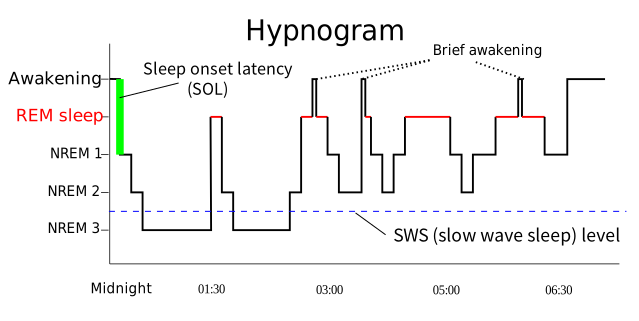 Hypnogram of a night’s sleep. Image: RazerM, Wikimedia Commons, licensed CC BY-SA 3.0.

During REM sleep the body does something specific. A 2015 review from John Peever’s lab at the University of Toronto describes a brainstem region, the subcoeruleus (sublaterodorsal) nucleus, that is active in REM sleep and is hypothesised to drive its defining features, including muscle paralysis, by activating neurons that inhibit the motor neurons. Blocking GABA and glycine receptors on motor neurons together prevents this paralysis, as the review summarises. The lock is an active process, not an absence of signal.
Its purpose is easy to see from what happens when it fails. In REM sleep behavior disorder, patients lose the muscle atonia and act out their dreams, sometimes injuring themselves or a partner.
When the mind wakes before the lock opens
Sleep paralysis is the same machinery caught between two states. The core features, as summarised on Wikipedia, are atonia, a clear sensorium and frequent hallucinations, and they appear to be universal even though cultures describe them very differently. Lifetime prevalence across 35 aggregated studies is about 8% of the general population, 28% of students and 32% of psychiatric patients.
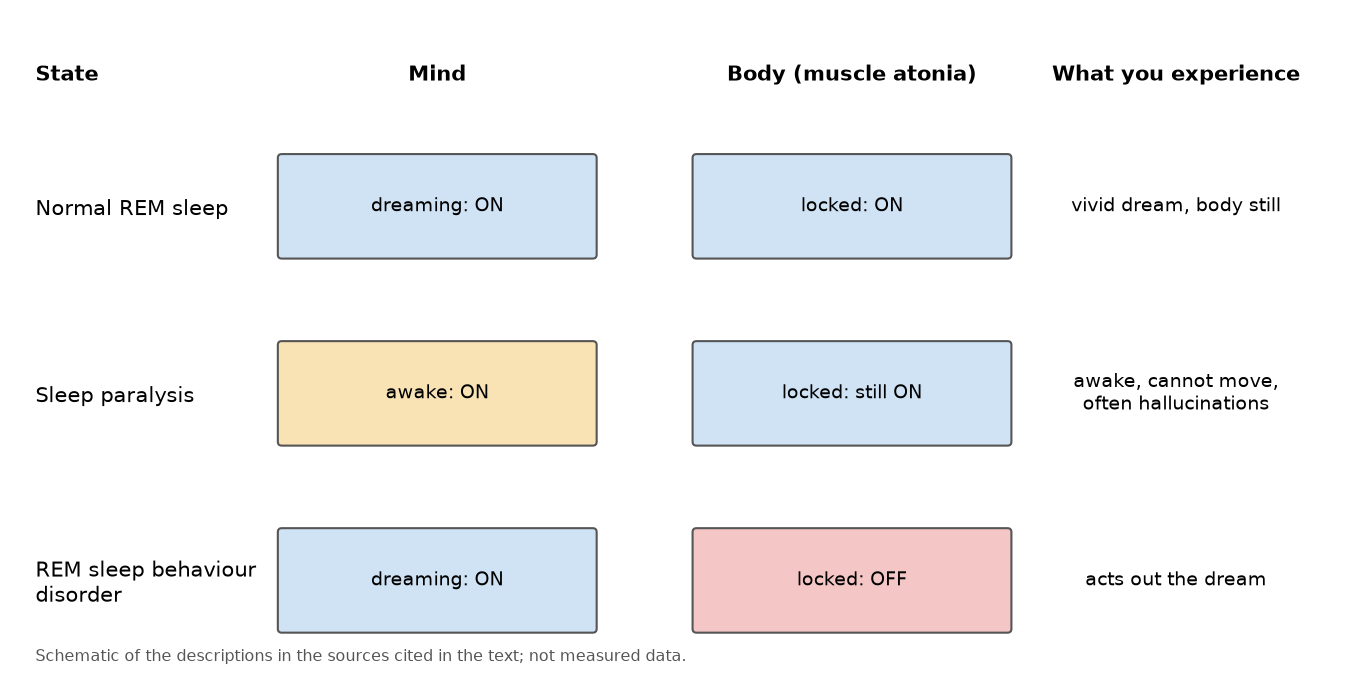 Three combinations of mind and muscle lock. A schematic of the descriptions in the sources above, not measured data.
The “presence in the room” that many people report in these episodes is also described in the literature, as a threat-vigilance response: the midbrain’s emergency system keeps running while the person is awake and unable to move. Researchers disagree about details, so the safe summary is the structural one. Paralysis plus a waking mind plus an alarm system produces a scene that feels like an intruder.
Out of the body, by electrode
In 2002 Olaf Blanke and colleagues described in Nature the repeated induction of an out-of-body experience by electrical stimulation of the right angular gyrus in a woman being evaluated for epilepsy. The same stimulation produced illusory changes in the patient’s arms and legs and a feeling of whole-body displacement. The authors’ reading is that such experiences may reflect a failure of the brain to integrate somatosensory and vestibular information.
Note the limits. It is one patient, and a patient with epilepsy. What it shows is that the sense of where “I” am relative to my body is constructed, and can be moved by changing the construction.
Twenty-one grams
The most famous number about the soul comes from 1907, when the Massachusetts physician Duncan MacDougall tried to weigh patients as they died. According to the summary on Wikipedia, he measured six patients; one lost three-quarters of an ounce (21.3 grams) at the time of death. In another, weight was lost and then regained, in two others it kept dropping minutes later, and MacDougall disregarded the results from two patients because of equipment problems. He also weighed fifteen dogs and found no change.
MacDougall himself said the experiment would have to be repeated many times before any conclusion could be drawn, and it is widely regarded as flawed and unscientific because of the sample size and the methods. One data point out of six is not a measurement of a soul. It is a story that survived because it was easy to repeat.
What all four leave unexplained
Each case above has the same shape. A strange experience is traced to a mechanism: a brainstem circuit, a stimulated cortex, a noisy scale. Nothing mysterious remains in how the paralysis happens, why the room feels occupied, or why a body seemed to float. These are what the philosopher David Chalmers called the “easy problems” in his 1995 paper “Facing Up to the Problem of Consciousness”: explaining function, dynamics and structure.
What remains is the hard problem: why any of these processes is accompanied by experience at all, why there is something it is like to be the subject. A complete account of the circuit does not obviously answer it, because the account is about what the brain does and the question is about what it is like.
The soul story fails at the scale, and the “it is just the brain” story fails at the question. Between them is a plain statement: the mechanisms are known and the experiencing is not. Calling it a weight, a ghost or an illusion all claim more than the evidence supports.
That leaves a modest conclusion that is easy to act on. If the experiencing self cannot be found on a scale or in a circuit diagram, it cannot be measured by what it weighs either. It can only be measured by what it does, and what a person does lasts in other people’s lives for as long as they remember it.