Thinking in Systems
A chapter-by-chapter walkthrough of Donella Meadows' Thinking in Systems: system structure, stocks and flows, feedback loops, resilience, surprises, traps, the twelve leverage points and dancing with systems, with the last two chapters checked against her own text.
Thinking in Systems: A Primer by Donella Meadows (Chelsea Green, 2008) is a short book with a large claim: a system’s behavior comes from its structure, not from the events that happen to it. According to Wikipedia’s entry, she circulated it as a draft in 1993, died in 2001, and it was restructured and published by colleagues at the Sustainability Institute, edited by Diana Wright. Meadows was the lead author of The Limits to Growth and trained under Jay Forrester at MIT.
The full book is under copyright, and unauthorized copies were not used. What could be read at the source was the publisher’s preview and the two chapters Meadows’ estate publishes free: the essay Leverage Points: Places to Intervene in a System and Dancing with Systems. The book’s chapters 6 and 7 expand these. For chapters 1 to 5 the post relies on the book’s published table of contents and a reader’s detailed chapter notes by Dan Lebrero, which could not be checked against the book’s pages. So:
- Sections 1 to 5 describe the book’s first five chapters as Lebrero’s notes record them, with the book’s examples where the notes name them.
- Sections 6 and 7 are checked against Meadows’ own text.
The book’s structure is: introduction, (1) The Basics, (2) A Brief Visit to the Systems Zoo, (3) Why Systems Work So Well, (4) Why Systems Surprise Us, (5) System Traps and Opportunities, (6) Leverage Points, (7) Living in a World of Systems.
1. What a system is
The book defines a system as a set of things interconnected in such a way that they produce their own pattern of behavior over time. It has three parts: elements, interconnections, and a function or purpose. 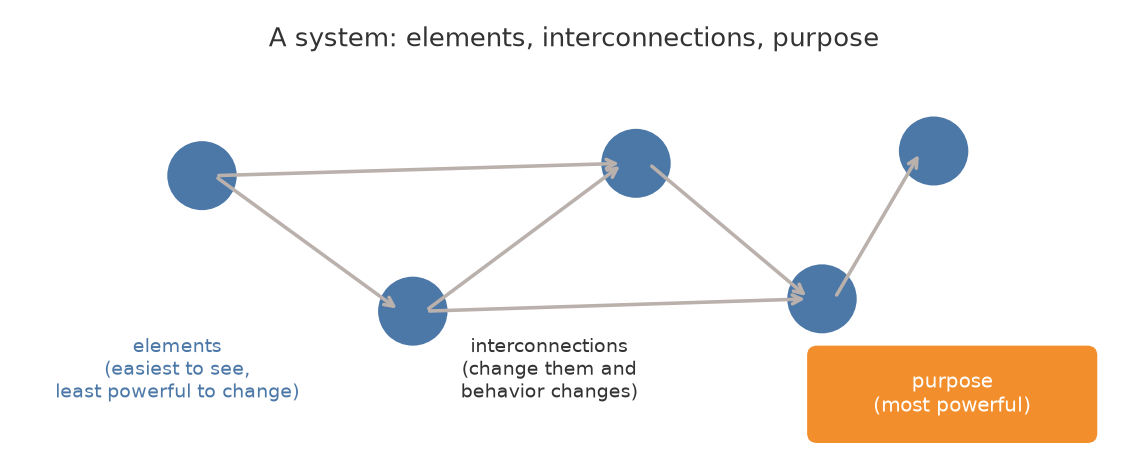 Figure 1. The three parts of a system, ordered by how much changing each one matters. After the book’s chapter 1. My own drawing.
The purpose is the least obvious and the most crucial determinant of behavior. Changing elements has the least effect; changing interconnections can alter the system greatly; changing the purpose is the most drastic. One frustrating feature is that the purposes of subunits may add up to an overall behavior that no one wants.
The central claim, as Wikipedia summarizes it, is that a system’s behavior is intrinsic to its structure, not caused by outside events. The range of behaviors it can show is set by its connections and feedback loops.
2. Stocks, flows and feedback
A stock is an element you can see, feel, count or measure at a given moment. It changes over time through flows, and because flows take time, stocks act as delays, buffers and shock absorbers. They let inflows and outflows be temporarily out of balance. A bathtub is the book’s model: the level changes only through the tap and the drain.
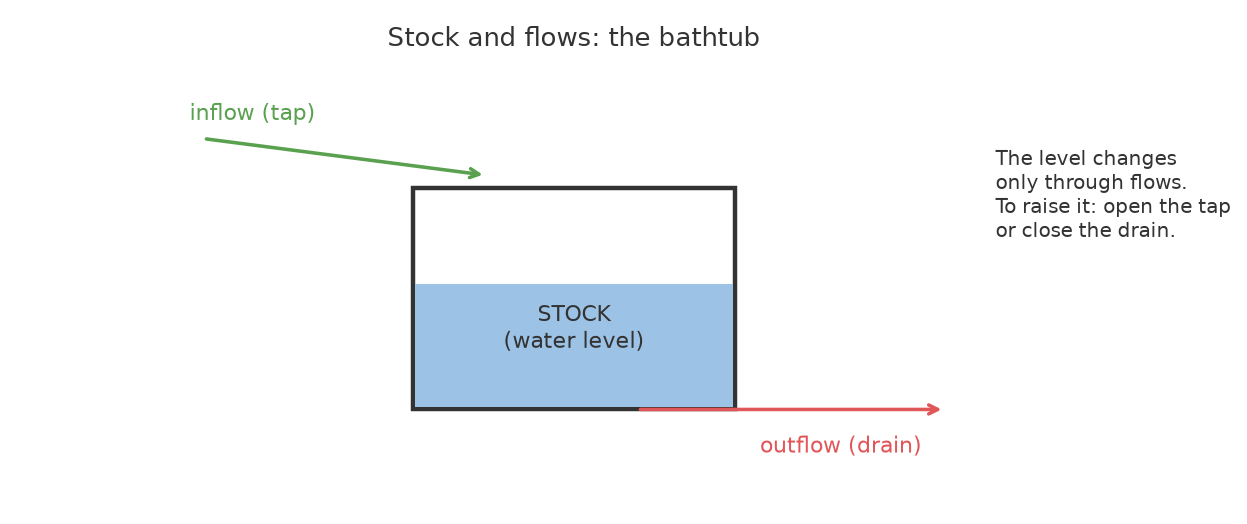 Figure 2. One stock, one inflow, one outflow. My own drawing. The notes record that the human mind focuses more easily on stocks than on flows, and more on inflows than on outflows.
A feedback loop exists when a change in a stock affects the flows into or out of that same stock. There are two kinds:
- Balancing loops are goal-seeking. They try to keep a stock at a given value or within a range, as a thermostat does. They may not be strong enough or fast enough.
- Reinforcing loops generate more input to a stock the more of it there is, which gives vicious or virtuous cycles, as compound interest does.
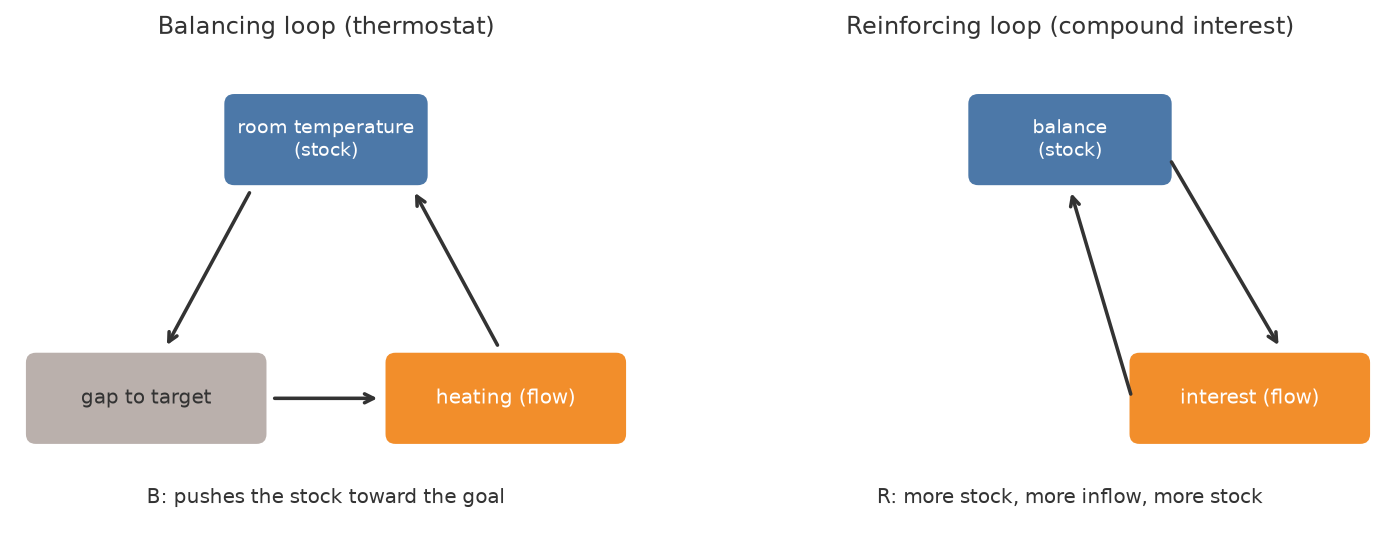 Figure 3. A balancing loop (B) closes the gap to a goal; a reinforcing loop (R) feeds on itself. My own drawing.
Information delivered by a feedback loop can only affect future behavior, so there is always a delay, and a delay in a balancing loop makes a system likely to oscillate. Systems with similar feedback structures behave similarly even when they look nothing alike.
Chapter 2 is a tour of simple systems: a stock with two competing balancing loops (a thermostat), a stock with one reinforcing and one balancing loop (population and the industrial economy), a system with delays (business inventory), and renewable stocks constrained by non-renewable or other renewable stocks (an oil economy, a fishery). The notes record the fishery’s three outcomes: if the balancing loop that slows growth is fast, the system settles to equilibrium; if slow, it oscillates; if too slow, it collapses.
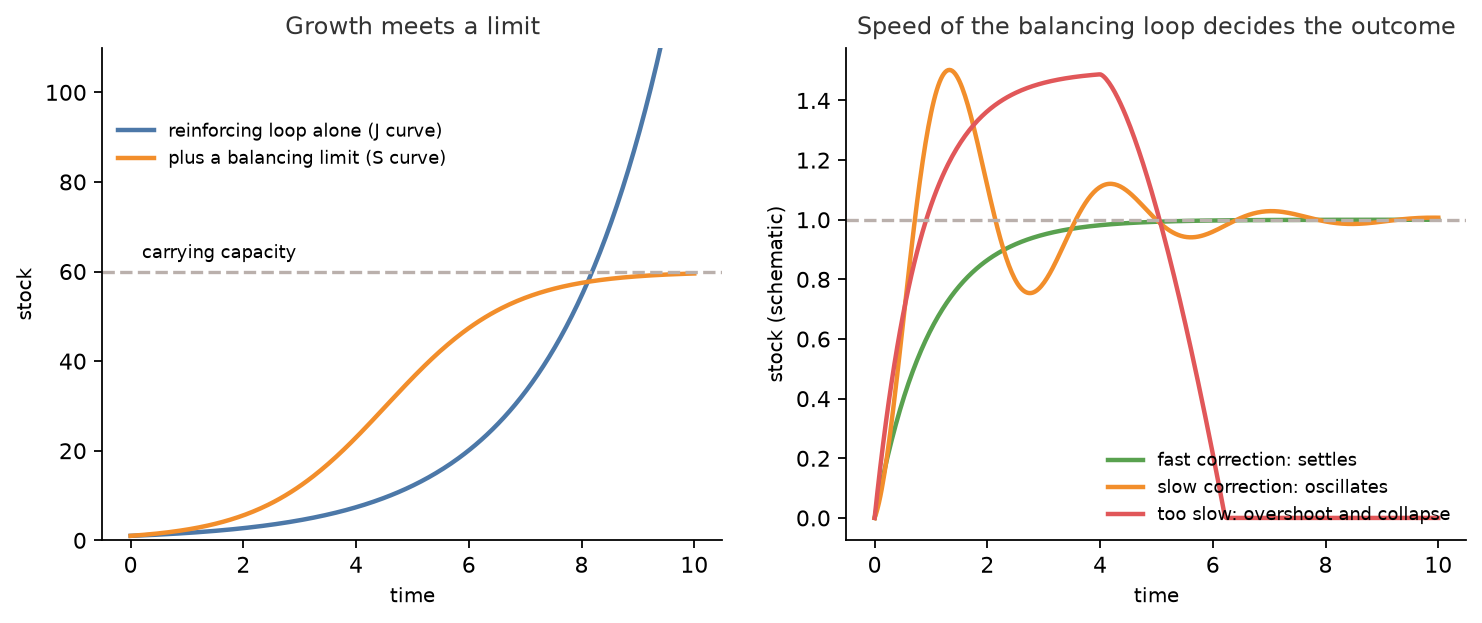 Figure 4. Left: a reinforcing loop alone grows without bound; a balancing limit turns it into an S curve. Right: the same goal-seeking loop settles, oscillates or collapses depending on how fast it responds. Schematic curves, not data. My own drawing.
3. Why systems work so well
Chapter 3 names three properties:
- Resilience is the ability to survive and persist in a variable environment (the term in this sense is C. S. Holling’s, 1973). It can be managed and enhanced, and it is not the same as being static.
- Self-organization is a system’s capacity to make its own structure more complex. It is fundamental to living systems, produces variety and unpredictability, and requires freedom and experimentation. The notes add that it is a threat to power structures.
- Hierarchy gives stability and resilience and reduces the cognitive load in the subsystems: links inside a subsystem are stronger than links across subsystems. Its original purpose is to help the subsystems do their job. The risks are sub-optimization and too much centralization.
The book’s warning is that resilience and self-organization are often sacrificed for short-term productivity and stability.
4. Why systems surprise us
Chapter 4 starts from the idea that everything we know about the world is a model, and models always fall short. It then lists six sources of surprise:
- Beguiling events. We watch events and pay too little attention to the history behind them. Structure is the source of behavior. Figure 5 shows the common way to picture this.
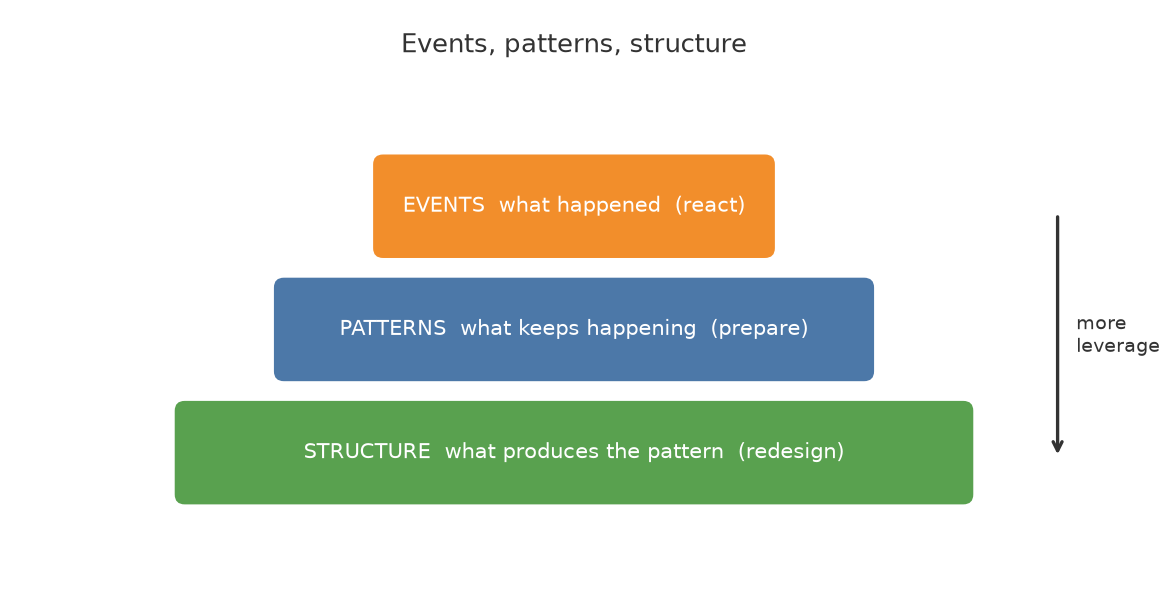 Figure 5. Events sit on the surface; the patterns and the structure that produce them are underneath. The three-level framing is a common teaching device that fits the book’s point; it is the post’s own drawing, not a figure from the book.
- Nonlinear relationships. They produce unexpected shifts between feedback loops (the spruce budworm example).
- Nonexistent boundaries. There is no single legitimate boundary around a system, and boundaries are of our own making, to be reconsidered for each problem. Too narrow a boundary produces surprises.
- Layers of limits. The most important input is the one that is most limiting, and growth changes what is limiting.
- Ubiquitous delays. Overshoots, oscillations and collapses are always caused by delays. Acting only when a problem is obvious misses the chance to solve it earlier.
- Bounded rationality. People make reasonable decisions on the information they have, which is imperfect, especially from distant parts of the system. The notes quote Herbert Simon’s term and record the conclusion: change comes from enlarging bounded rationality with better, more complete and timelier information.
5. System traps and opportunities
Chapter 5 catalogs archetypes, recurring structures that produce stubborn problems in different settings. As Lebrero’s notes list them, with the way out:
- Policy resistance. Actors pull a stock toward different goals, and each pull forces the others to pull harder. Everyone works to maintain a result that nobody likes. The war on drugs is the example in the notes. The way out is to align the actors to a larger goal or negotiate solutions that satisfy all of them.
- The tragedy of the commons (Hardin, 1968). A shared, erodible resource whose users get the benefit directly while the costs of abuse are shared, with weak feedback from the resource’s condition. The ways out are education and exhortation, privatization (to strengthen the feedback) and regulation.
- Drift to low performance. Performance standards are influenced by past performance, creating a reinforcing loop of eroding goals. The way out is to keep standards absolute, or to make them sensitive to the best historical performance.
- Escalation. Each side’s state is determined by trying to surpass the other’s (arms races). Refuse to compete, or negotiate a new system with balancing loops.
- Success to the successful. Winners are rewarded with the means to win again, until winners take all. The ways out include diversification, antitrust limits and policies that level the playing field.
- Shifting the burden to the intervenor. An intervention treats symptoms and erodes the system’s own ability to look after itself, so it needs more intervention (addiction is the example). Strengthen the system’s ability to carry its own burdens, and favor long-term restructuring over short-term relief.
- Rule beating. Behavior that appears to obey the rules while distorting the system. Design rules so that creativity goes toward the purpose of the rules.
- Seeking the wrong goal. Goals defined inaccurately produce results nobody wanted. Define outcomes, not outputs.
6. The twelve leverage points
The book’s sixth chapter is its centerpiece. The claim is that in a complex system the places to intervene are not equal: some take enormous effort for a small effect and others move the whole system with a light touch. This part follows Meadows’ own essay, which became the book’s chapter 6.
Her opening point is that leverage points are counter-intuitive. Jay Forrester’s story: he would analyze a company, find a leverage point, and then find that everyone was already pushing on it, in the wrong direction. The model for the Club of Rome (World3, the model behind The Limits to Growth) found growth itself to be the leverage point, while the world’s leaders were pushing growth as the answer to everything. She is also clear that the list is tentative, “slithery” in order, and “not a recipe”. Her own wording of the list, in increasing order of effectiveness (Figure 6):
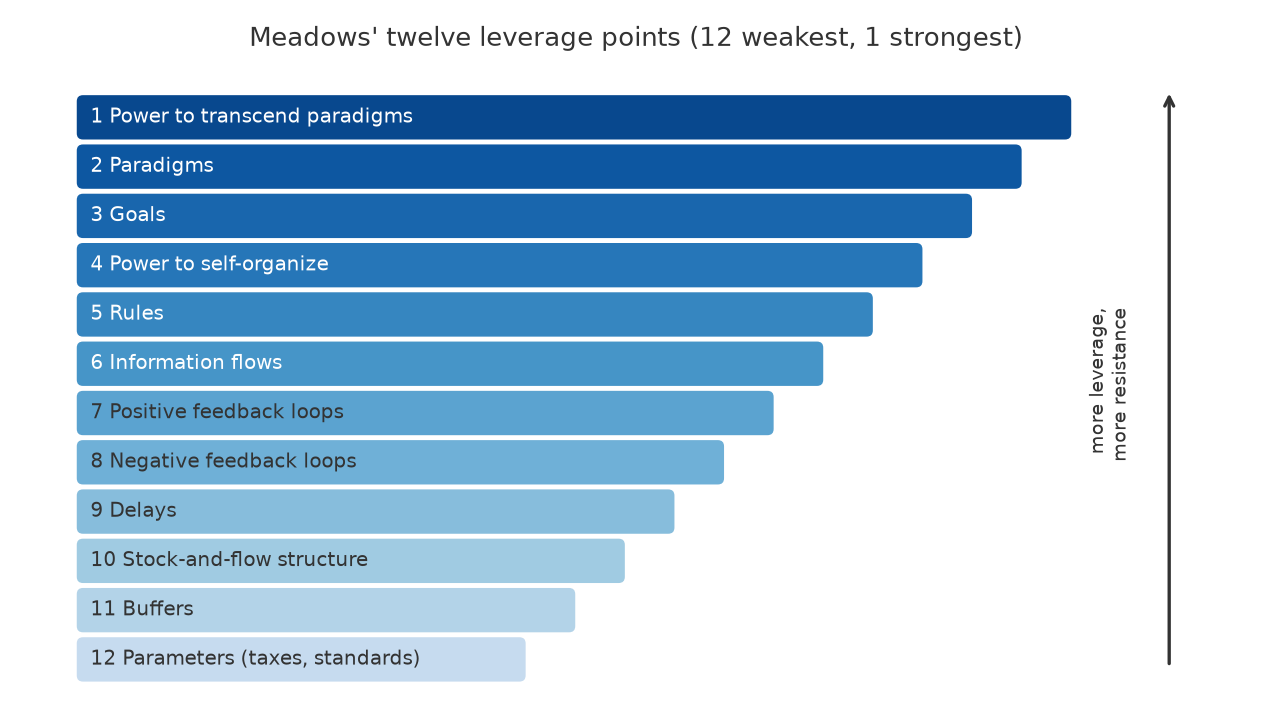 Figure 6. Meadows’ twelve leverage points, from the weakest (12) to the strongest (1). The shorter bars are the ones most attention goes to. After her essay. My own drawing.
- Constants, parameters, numbers (subsidies, taxes, standards).
- The sizes of buffers and other stabilizing stocks, relative to their flows.
- The structure of material stocks and flows (transport networks, population age structures).
- The lengths of delays, relative to the rate of system change.
- The strength of negative feedback loops, relative to the impacts they are trying to correct against.
- The gain around driving positive feedback loops.
- The structure of information flows (who does and does not have access to information).
- The rules of the system (incentives, punishments, constraints).
- The power to add, change, evolve, or self-organize system structure.
- The goals of the system.
- The mindset or paradigm out of which the system arises.
- The power to transcend paradigms.
The descriptions below follow her essay.
12, parameters. Taxes, minimum wage, air-quality standards. She says probably 90, 95, 99 percent of our attention goes here, and there is little leverage in it: “arranging the deck chairs on the Titanic”. Parameters rarely change behavior, and electing a different president changes little because every president is plugged into the same system. The caveat: a parameter matters when it pushes the system into a range that triggers something higher on the list, such as the gain of a reinforcing loop.
11, buffers. Big stocks relative to their flows are stable: lakes flood less often than rivers, and savings keep you steady where living on cash flow does not. Too big a buffer makes a system inflexible and costly, which is why firms adopted just-in-time inventory. Buffers are usually physical and hard to change, so they sit low.
10, stock-and-flow structure. Hungary’s road layout sent all cross-country traffic through Budapest, which no traffic light fixes. Rebuilding is the slowest and costliest change. The real leverage is getting the design right the first time.
9, delays. In her London hotel shower the water took a minute to respond to the tap, and she oscillated between scalding and freezing. A delay matters relative to the rate of change of the thing being controlled. Power plants take years to build and last decades, so electricity industries swing between over- and under-capacity. Delays are hard to change, so it is usually easier to slow the system down. She adds that this is why a very large central planning system, like the Soviet Union or General Motors, functions poorly.
8, negative feedback. A loop needs a goal, a sensor and a response. We often strip out rarely used “emergency” loops because they look costly, and narrow the range of conditions the system can survive. Her examples include our own time for rest and meditation. Strength matters relative to the impact being corrected: a thermostat copes in winter and fails with all the windows open. Markets and democracy are negative feedback systems that depend on honest information, and she argues that distorting price signals and the flow of information between voters and leaders weakens both.
7, positive feedback. Reducing the gain on a reinforcing loop is usually a stronger lever than strengthening a balancing one, “the same as slowing the car when you’re driving too fast, rather than calling for more responsive brakes”. Her example of success to the successful: rich people earn interest and poor people pay it. Anti-poverty programs are weak balancing loops against strong reinforcing ones, and weakening the reinforcing loops (progressive taxation, inheritance tax, universal public education) would do more. A reinforcing loop speeding up past what balancing loops can follow produces chaos.
6, information flows. Two houses, identical in everything except the electric meter: in some it was in the basement, in others in the front hall where residents saw it spin. Consumption was 30 percent lower where it was visible. That is not a parameter change but a new loop. The second example is the US Toxic Release Inventory, which since 1986 has required factories to report emissions publicly. No law, no fines, only information, and by 1990 emissions had fallen 40 percent. One chemical company cut emissions by 90 percent to get off the “Top Ten Polluters” list. (The EPA’s TRI page describes the program today.) Missing feedback is one of the commonest causes of malfunction, and it has to be restored to the right place in a compelling form. Her thought experiments: a town’s water intake must sit downstream of its own outflow; decision makers on nuclear plants store the waste on their lawns.
5, rules. Rules define a system’s scope and degrees of freedom. She asks students to imagine a college where students grade teachers, there are no degrees, or a class is graded as a group. Power over rules is real power, which is why lobbyists gather when laws are written and why the court that interprets the constitution is more powerful than the legislature.
4, self-organization. The power to change the system’s own structure is the strongest form of resilience: a system that can evolve can survive almost any change by changing itself. She argues the “divine creator, if there is one” only has to write clever rules for self-organization, and the DNA code has been constant for something like three billion years. It needs a variable stock of raw material (DNA, accumulated science, culture) and a way to test variations. That is why biologists value biodiversity, and she calls letting species go extinct “a systems crime”. Encouraging experiment and diversity means losing control, so we tend to push this lever the wrong way.
3, goals. The goal beats the ability to self-organize, because a goal of bringing everything under central control will twist everything below it. Her example is that a corporation’s stated goal is profit, but profit is a rule, a condition of staying in the game. The actual goal is to grow and shield itself from uncertainty, which “is the goal of a cancer too”. A single leader at the top can change a goal and swing thousands of intelligent people: she cites Ronald Reagan’s shift from asking what you can do for government to getting government off our backs. Her point is that a system’s real goal is what its behavior shows, not what it declares.
2, paradigms. The shared unstated assumptions of a society from which its goals, rules and structure arise. Forrester’s remark: whatever a country’s tax law says, actual tax payments will push up against the society’s idea of fairness. She quotes Emerson on how every nation surrounds itself with a material apparatus that corresponds to its state of thought. Her examples of paradigm shifts: Copernicus and Kepler, Einstein, Adam Smith. She says paradigm change can be instant in one mind but societies resist it harder than anything. Following Thomas Kuhn’s The Structure of Scientific Revolutions, you keep pointing at the anomalies and failures of the old paradigm, speak with assurance from the new one, and place its holders in positions of visibility, spending your effort on the open-minded middle and not on reactionaries. Systems people, she adds, change paradigms by modeling a system, which takes you outside it and forces you to see it whole.
1, the power to transcend paradigms. This is the highest item on her list. It is “to keep oneself unattached in the arena of paradigms, to stay flexible, to realize that NO paradigm is ‘true’”, including the one that shapes your own view. She calls it letting go into Not Knowing, and says that if no paradigm is right, you can choose whichever helps your purpose.
Her closing caution is the part to remember. The list is tentative. The higher the leverage point, the more the system resists changing it. There are “no cheap tickets to mastery”, and mastery has “less to do with pushing leverage points than with strategically, profoundly, madly letting go”.
7. Dancing with systems
The book’s last chapter grew out of her essay Dancing with Systems. It opens with a warning: people who come to systems thinking from the industrial world tend to make “a terrible mistake”, which is to assume that this is the key to prediction and control. She says she and her MIT classmates believed that. But self-organizing, nonlinear feedback systems are “inherently unpredictable” and “not controllable”. The goal of foreseeing the future exactly is unreachable. What remains is a different kind of doing: the future cannot be predicted, but it can be envisioned and lovingly brought into being. “We can’t control systems or figure them out. But we can dance with them!”
She draws the image from whitewater kayaking, gardening, music and skiing, which all require you to stay awake, pay close attention and respond to feedback. Her fourteen guidelines:
- Get the beat. Watch how the system behaves, and learn its history, before disturbing it. This keeps you on facts instead of theories, and it stops you defining a problem as the absence of your favorite solution.
- Listen to the wisdom of the system. Support the structures that help the system run itself. Her example is aid workers in Guatemala who walked past a thriving local market on their way to “create jobs”.
- Expose your mental models to the open air. Everything anyone knows is a model. Let others shoot at it and collect as many as you can.
- Stay humble. Stay a learner. When you do not know, do not bluff and do not freeze: experiment, and embrace error.
- Honor and protect information. She guesses 99 percent of what goes wrong in systems goes wrong because of faulty or missing information, and proposes an Eleventh Commandment: do not distort, delay or sequester information.
- Locate responsibility in the system. Look at how the system produces its own behavior, and design for “intrinsic responsibility”, meaning feedback about consequences reaches the decision-makers directly. Her example is the central thermostat at Dartmouth, which removed that feedback and made things worse.
- Make feedback policies for feedback systems. Her example is Jimmy Carter’s proposal for a gasoline tax proportional to the fraction of oil that was imported, which would fall to zero as imports did. It was never passed.
- Pay attention to what is important, not just what is quantifiable.
- Go for the good of the whole. Do not optimize a part while ignoring the whole. She quotes Kenneth Boulding: don’t go to great trouble to optimize something that should not be done at all.
- Expand time horizons. In the systems sense there is no long term and short term, only nested time scales. Watch the next step and the horizon both.
- Expand thought horizons. Follow a system across disciplines.
- Expand the boundary of caring. Systems thinking supplies practical reasons for the moral rules.
- Celebrate complexity.
- Hold fast to the goal of goodness. Do not weigh bad news more heavily than good, and keep standards absolute.
Her last point: systems thinking can only tell us to do these things, it cannot do them for us. It leads to the edge of what analysis can do and points beyond, “to what can and must be done by the human spirit”.
My additions
These are the post’s, not Meadows’.
- The events-versus-structure distinction (chapter 4) is also how to debug a model or an agent. A bad output is an event. The same failure class across many prompts is a pattern. The training data, objective, or tool design that makes it likely is the structure. Fixing outputs one by one treats events and leaves the structure alone.
- Meadows’ point that a system’s goal is what its behavior shows matches the warning about metrics. When a measure becomes a target, it stops measuring (Goodhart’s law). A model optimized against a proxy will pursue the proxy, whatever the designer meant. That is her goal-of-the-system lever applied to training.
- Her information-flow lever is the cheapest one for anyone building with LLMs. Make the failures visible to the person who can fix them (logs, evaluations, a displayed cost) before changing anything else. The electric meter in the front hall is the pattern.
- Her last two levers explain why the first drafts of most plans are about parameters. A parameter is easy to state and to argue about. A goal or a paradigm is hard to state and risky to argue about, and so most discussion happens in the lowest slots of her list.