How to Think Clearly (1/11): Where Thinking Breaks and What to Put There
A map of the series: six places where thinking fails, the safeguard for each, and the posts that cover them.
This series treats clear thinking as a practice with known failure points. Thinking does not break at random. A mind with a small working memory, a pull toward the easiest option, a habit of mistaking its models for the world, poor instincts about size and odds, and a new habit of asking machines that tend to agree, fails in the same places again and again.
Each post takes one failure point, shows the evidence for it from the original studies or sources, and offers one safeguard. A safeguard here means a decision made before the moment of failure, while thinking is still clear. Odysseus did not resist the Sirens by willpower; he had himself tied to the mast beforehand. The rest of the series is that move, applied six ways.
The map
The stages run from the inside out: the mind, the setting around it, the beliefs it holds, the estimates it makes, the direction it chooses, and the tools it hands work to.
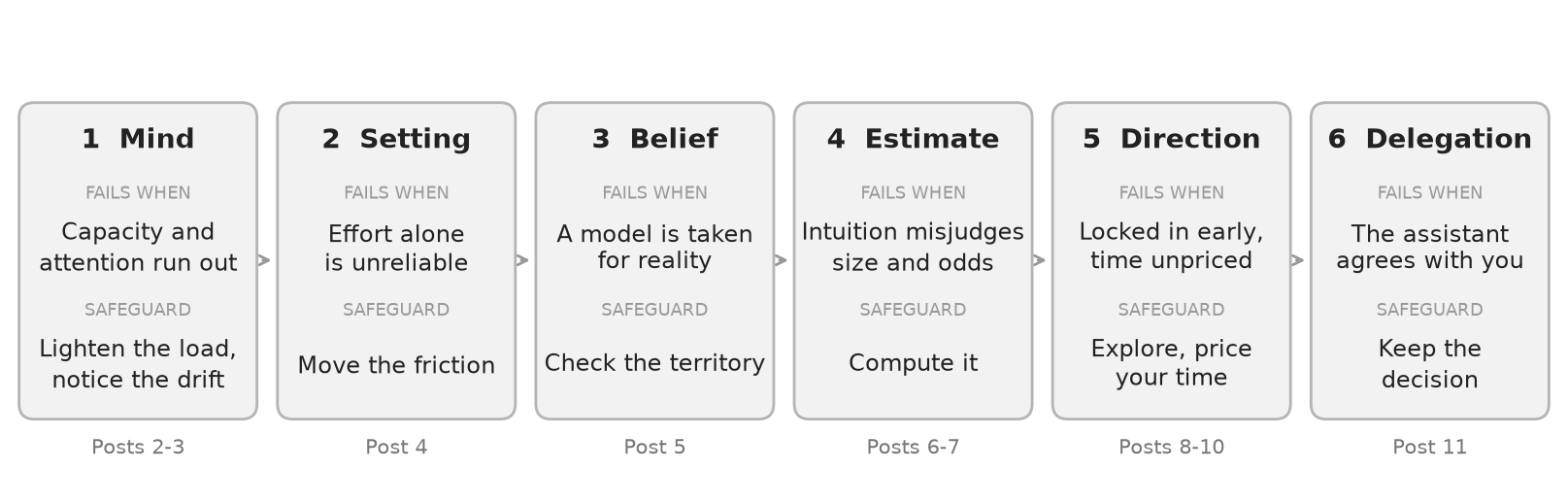 The six stages of the series. Every post carries this figure with its own stage highlighted.
How each post works
Each post opens by saying where it sits on the map. Claims come from named sources, read in the original wherever possible. Where a result reaches the post only through a secondary source, the post says so. Where an argument or a simulation is the author’s own, the post marks it as such.
Contents
| # | Post | Stage | Fails when | Safeguard |
|---|---|---|---|---|
| 1 | Where Thinking Breaks and What to Put There | - | Thinking breaks at known points | A decision made before the failure |
| 2 | A Thought Has a Machine Behind It | Mind | Capacity and attention run out | Lighten the load |
| 3 | Catch the Error While It Happens | Mind | Failures go unnoticed | Notice confusion, avoidance and “should” |
| 4 | Make the Right Thing the Easy Thing | Setting | Effort alone is unreliable | Move the friction |
| 5 | The Map Is Not the Territory | Belief | A model is taken for reality | Check the territory |
| 6 | Three Tools for Estimating the Unknown | Estimate | Intuition misjudges size and odds | Compute it |
| 7 | Averages Lie | Estimate | The average hides a few huge cases | Look at the distribution |
| 8 | Price Your Own Hour | Direction | Time is spent unpriced | Put a number on it |
| 9 | Explore Early, Exploit Late, Imagine the Failure First | Direction | Locked in too early | Explore, then run a premortem |
| 10 | The Hill You Are Standing On | Direction | A small peak feels like the top | Test for a higher peak |
| 11 | Let AI Think, Keep the Decision | Delegation | The assistant agrees | Keep the decision |
Reading order
Read in order, since each post starts where the previous one stopped. Or read by need: when effort keeps failing, post 4; when numbers mislead, posts 6 and 7; when stuck, posts 8 to 10.