Knowing How It Works Does Not End the Wonder
A popular answer to the silent sky says civilizations stop once they understand everything. The idea is older than SETI, and it fails for the same reasons it always has.
The sky is quiet. The Fermi paradox asks why, and Robin Hanson’s 1998 essay on the Great Filter gave the quiet a structure: somewhere between dead matter and a civilization that fills the galaxy, there is a step almost nothing gets past. Most discussion asks whether that step is behind us (life is hard to start, intelligence is rare) or ahead of us.
One popular answer puts it ahead, and puts it in the mind. A civilization that fully understands its own mechanisms, down to why it is curious and what satisfies it, has nothing left to want. Once the trick is explained, the show is over. The civilization is not destroyed. It simply stops.
That is a claim about wonder, and it can be tested against what we know about wonder.
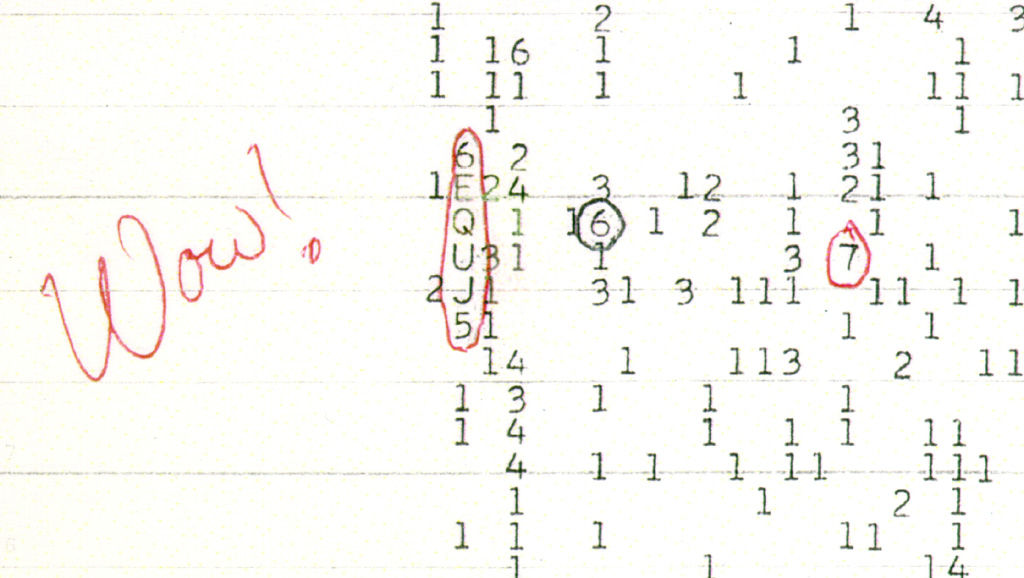 The 1977 Wow! signal printout. Ohio State’s Big Ear telescope recorded a narrowband signal that fills the full 72-second observing window, peaks at a level thirty standard deviations above the noise, and has never recurred. Credit: Big Ear Radio Observatory and North American AstroPhysical Observatory (NAAPO), public domain.
An old fear
The worry that explanation drains the world is two centuries old. At a dinner in December 1817, Keats agreed that Newton “had destroyed all the poetry of the rainbow, by reducing it to the prismatic colours.” In Lamia he wrote:
Do not all charms fly At the mere touch of cold philosophy? […] Unweave a rainbow, as it erewhile made The tender-person’d Lamia melt into a shade.
Richard Dawkins took the last phrase as the title of Unweaving the Rainbow, an argument that science finds poetry in the patterns of nature rather than removing it.
Richard Feynman gave the short version. An artist friend held up a flower and said a scientist takes it apart and makes it dull. Feynman, in his own words:
I can appreciate the beauty of a flower. At the same time, I see much more about the flower than he sees. […] All kinds of interesting questions which the science knowledge only adds to the excitement, the mystery and the awe of a flower. It only adds. I don’t understand how it subtracts.
Why the mechanism argument fails
What follows is my own argument, in three steps.
An explanation is also a source of questions. Feynman’s flower is explained by pollination, which raises the question of what insects see, which raises the question of whether an aesthetic sense exists in other animals. Each answer is a new frontier. A civilization that “finished” explaining itself would be one for which the explanations stopped generating questions, and nothing we know about explanation behaves that way.
The magic trick is the wrong model. A trick is built to hide its method, so the method is anticlimactic by design. A law of nature is not concealing anything. The same arithmetic that shows light from the Andromeda galaxy left 2.5 million years ago does not make the sky less strange. The mechanism behind sleep paralysis is fully described, and the experience is no less vivid for it. Understanding changes what the wonder is about. It does not remove it.
A complete self-model is not a complete account of the self. Even if every circuit of a mind were mapped, why any of it is accompanied by experience would still be the hard problem. The premise of the argument, that mechanism is all there is to a drive, is the part nobody has shown.
What the quiet actually supports
Nothing observed favours the proposal. John Smart’s transcension hypothesis, the nearest published relative, says something different: that advanced civilizations migrate into “inner space,” a domain of increasingly dense, efficient and miniaturized computation, ending in a black-hole-like destination. It is motivated by growth, not by loss of motive. The “understood, therefore pointless” version is an intuition, and it borrows the Fermi paradox for authority it has not earned.
Silence has many candidate explanations, and the honest summary is that none is confirmed. The one anomalous signal in the record, six characters on a printout, is still unexplained after almost fifty years.
The principle
Knowing how something works answers a question and opens a better one. Wonder was never a product of ignorance. It is a response to depth, and depth is exactly what explanation reveals. A mind that stops wanting once it understands has not understood too much. It has treated the first layer as the last.