Matter That Asks Why
We are made of star-stuff is an inventory. We are a way for the cosmos to know itself is a different kind of claim. Separating the two.
Carl Sagan’s line from Cosmos has been repeated until it reads like decoration:
We’re made of star-stuff. We are a way for the cosmos to know itself.
The first sentence is a measurable fact. The second is a claim that needs more care. This post separates them.
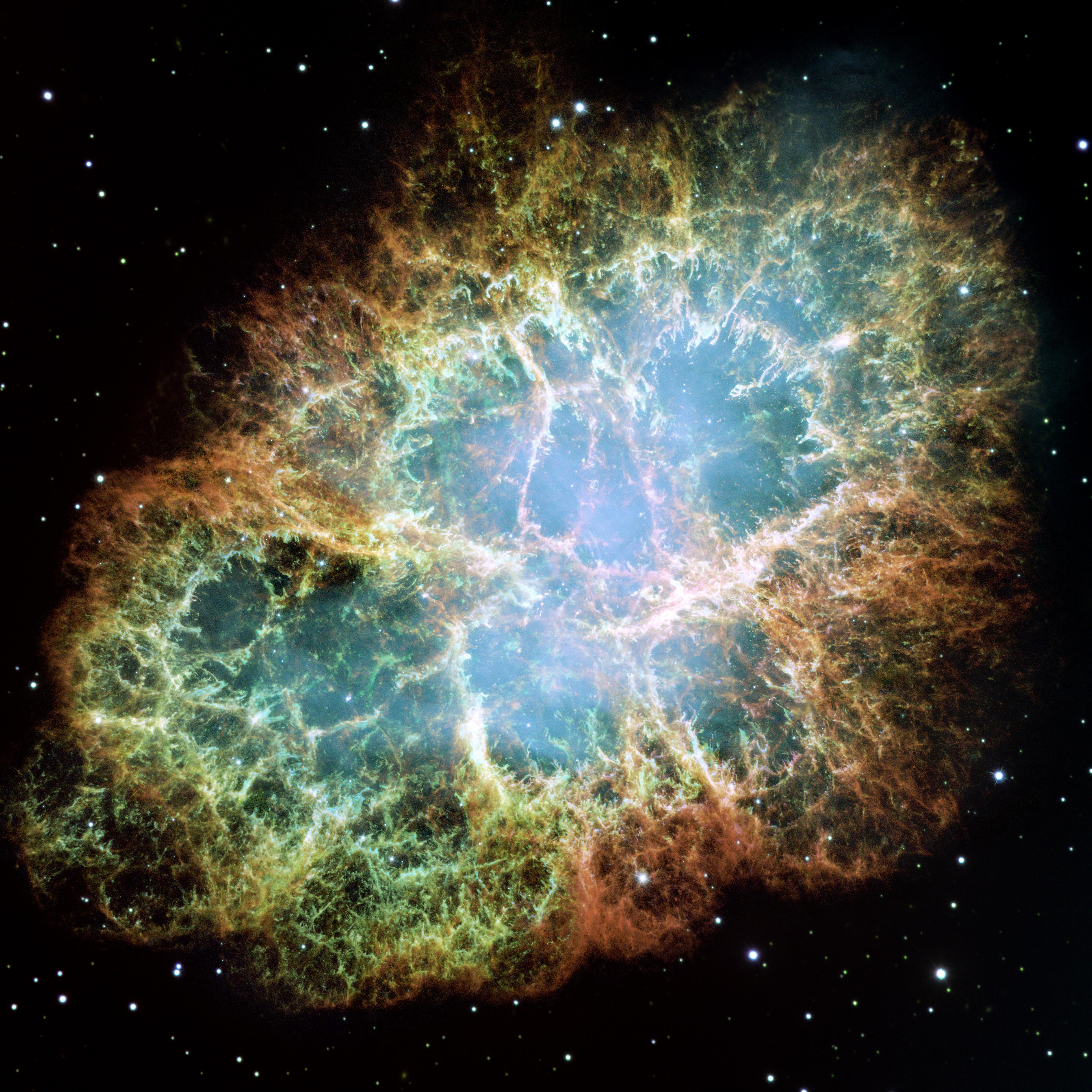 The Crab Nebula, assembled from 24 Hubble exposures. Elements heavier than hydrogen are made in stars and returned to space like this. Credit: NASA/ESA/JPL/Arizona State Univ.
The first sentence is literal
Hydrogen was made within a few hundred seconds after the Big Bang. Heavier elements were mostly made much later in stars, and elements up to iron by large stars as they become supernovae. The 1957 paper by Burbidge, Burbidge, Fowler and Hoyle, “Synthesis of the Elements in Stars”, is the standard account of how.
The human body is about 96 percent four elements by mass: oxygen (65), carbon (18.5), hydrogen (9.5) and nitrogen (3.3). Put the two facts together: the hydrogen is as old as the universe’s first minutes, and the oxygen, carbon and nitrogen came out of earlier generations of stars. “Star-stuff” is just inventory.
Nothing special was added
What is notable is what the inventory does not contain. Nothing in the list is rare. Oxygen, carbon, hydrogen and nitrogen are among the most common elements around. No ingredient is exotic. The body is a particular arrangement of ordinary matter, kept in that arrangement by a continuous throughput of energy.
The argument against a weighable soul in the previous post arrives at the same result from the other side. If a person is arranged ordinary matter, there is nothing extra to find on a scale.
The second sentence is not inventory
“A way for the cosmos to know itself” is a different kind of statement. It does not follow from the abundance tables. It is a way of describing what happens when matter is arranged so that it models its surroundings, including itself.
Here the honest position matches the one in the last post. The mechanisms of cognition are an engineering question and are being worked out. Why that arrangement is accompanied by experience at all is the hard problem, and no inventory of atoms bears on it. Sagan’s sentence names the puzzle in poetic form without solving it.
What the ordinariness means
There are two ways to take “just ordinary matter.” One treats it as a deflation: if the parts are cheap, so is the whole. The other notices that the parts being cheap is exactly what makes the whole remarkable. A universe that produces thinking from its most common ingredients has not spent anything rare to do it.
That is my argument, not a finding. The data only says that the matter is common and that thought exists. What follows from it is a choice of emphasis, and the more accurate one is the second: ordinary matter becoming able to ask why it exists is not an ordinary event. The ingredients explain the first half of that sentence only.