The Dark Is Light That Has Not Arrived
If the universe were infinite and full of stars, the night sky would blaze. Olbers' paradox, its real history, and why dark means not yet.
If the universe is infinite and filled with stars, every line of sight should end on a stellar surface. The night sky should be as bright as the Sun’s disk. It is dark instead. The question has a name, Olbers’ paradox, and a longer history than its name suggests.
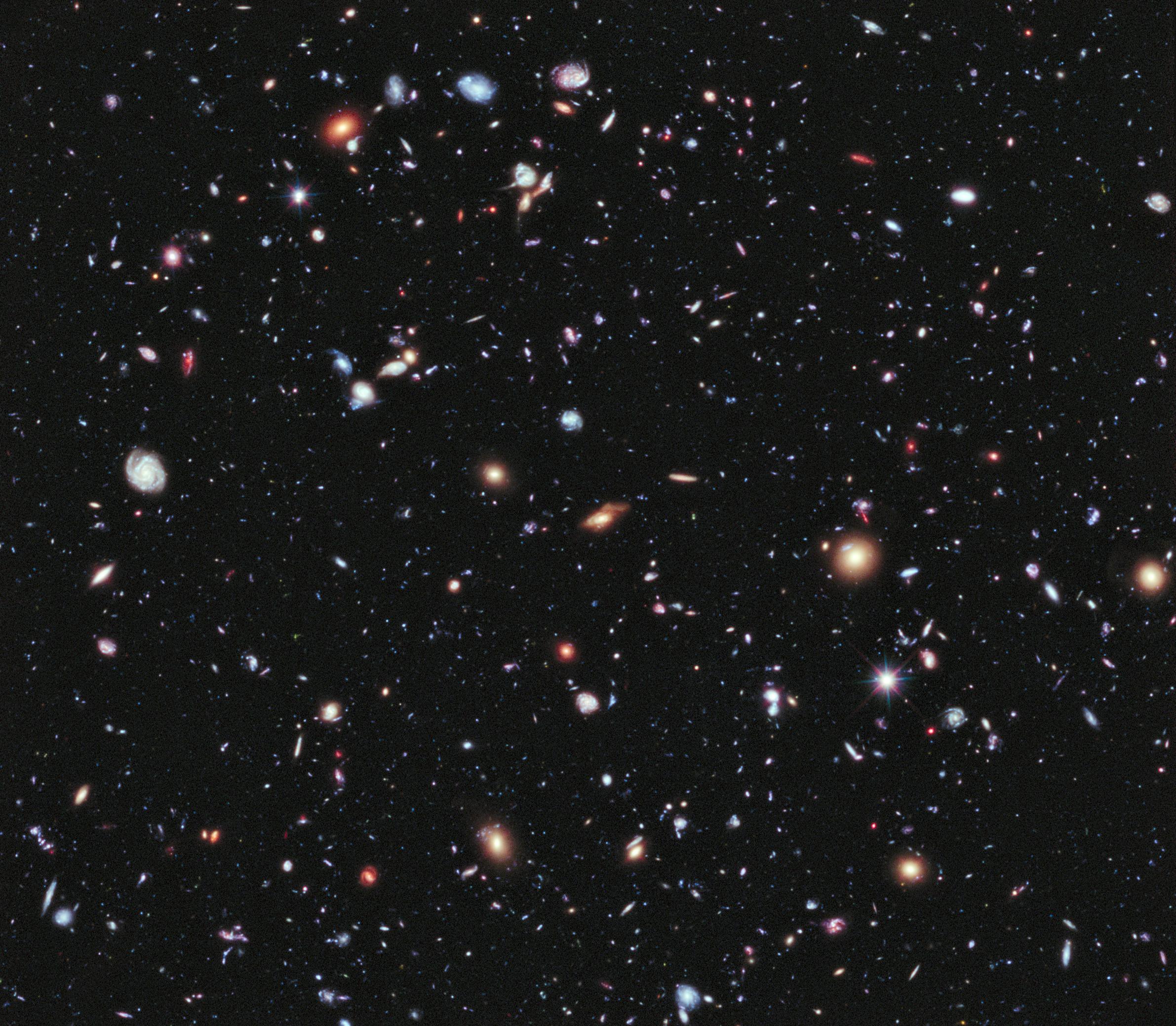 Hubble eXtreme Deep Field: about 5,500 galaxies in a patch of sky that is a small fraction of the angular diameter of the full Moon. Between them, the sky is dark. Credit: NASA; ESA; G. Illingworth, D. Magee, and P. Oesch, University of California, Santa Cruz; R. Bouwens, Leiden University; and the HUDF09 Team.
An old question with the wrong name
By Edward Harrison’s history (as summarised on Wikipedia), the first person to conceive of anything like the paradox was Thomas Digges. Kepler posed it in 1610, and Halley and Jean-Philippe Loys de Cheseaux gave it its mature form in the 18th century. Heinrich Olbers described it in 1823, and his name stuck, although Harrison points out that Olbers was far from the first and that his own thinking on it was not particularly valuable.
The argument is clean. Divide space into thin shells around us. A shell twice as far away holds four times as many stars, each a quarter as bright, so every shell contributes the same light. Infinitely many shells give an infinitely bright sky.
The fixes that failed
Dust does not work. Starlight absorbed by dust heats the dust, and in an eternal universe the dust eventually glows as brightly as what it hid. The sky would not be infinitely bright, but every point would look like the surface of a star.
The fix that works is in the premises. Edgar Allan Poe’s 1848 prose poem Eureka came close to it in words:
The only mode, therefore, in which, under such a state of affairs, we could comprehend the voids which our telescopes find in innumerable directions, would be by supposing the distance of the invisible background so immense that no ray from it has yet been able to reach us at all.
The first publication of this solution in the scientific literature was by Johann Heinrich von Mädler in 1858: a universe of finite age. Lord Kelvin set out a satisfactory mathematical version in 1901.
Two reasons, not one
Finite age does most of the work: the number of visible stars is bounded because light has had only about 13.8 billion years to travel. Expansion adds a second effect. The line of sight in a real universe does not end on a star but on the surface of last scattering, where light from the Big Bang first emerged. ESA’s Planck summary puts that at roughly 380,000 years after the beginning; since then expansion has stretched those photons to about a millimetre in wavelength and cooled them to 2.7 K. The sky behind the stars is not empty. It is full of light that has become invisible to the eye.
The numbers also expose a common confusion. The observable universe is about 92 billion light-years across although the universe is only 13.8 billion years old, because the space the light crossed was growing while it travelled. The edge of what we can see is an edge of information, not a wall.
Dark as a time, not a place
The first post in this series argued that every distance is a delay: to look far is to look back. Olbers’ paradox carries that to its limit. A lit patch of sky is light that has already arrived, which is the past of something. A dark patch is not necessarily empty. It may only be light that has not had time to get here.
For the sky, dark means not yet, and nothing more. That reading is my own extension, not an astronomical claim. But it is a useful habit. Whenever a region of what we know is blank, there are two possible readings: nothing is there, or the signal has not arrived. They look identical from inside, and only one of them is a statement about the world.