How to Think Clearly (2/11): A Thought Has a Machine Behind It
Attention, working memory and executive control: the three parts of a thought, the real size of the desk, and what a half-finished task costs.
Where this sits: stage 1 of 6, the Mind. The first post draws the map of the whole series. This stage covers the machinery of a single thought and the limits it carries.
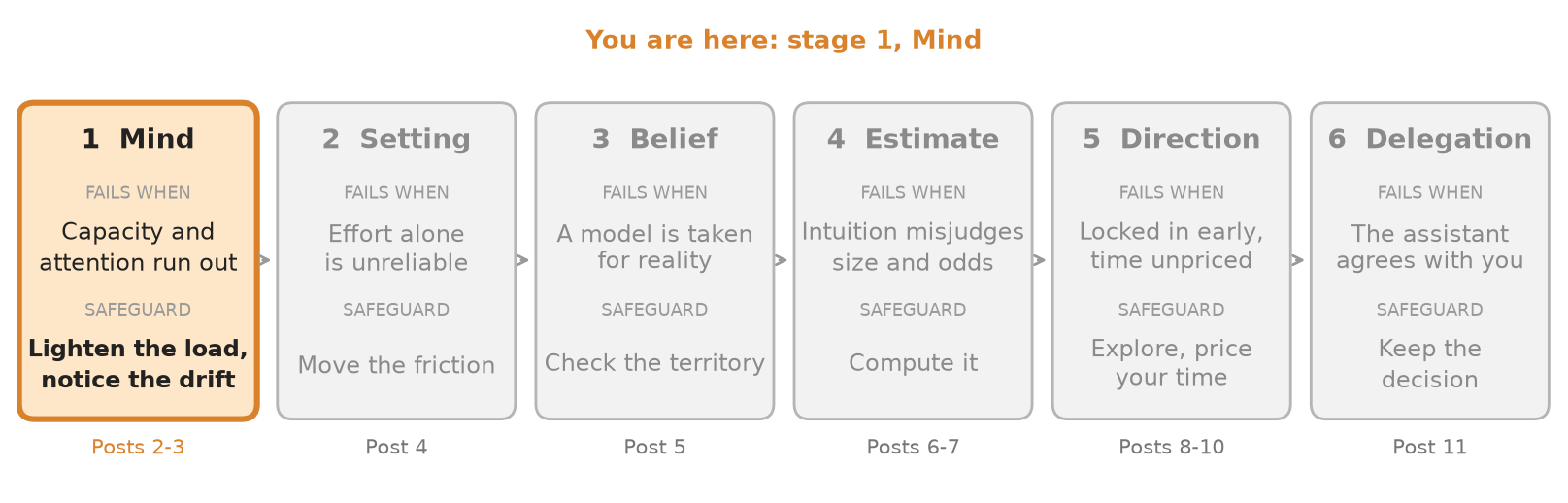 Where this post sits in the series: stage 1 of 6, Mind.
Earlier posts in this blog asked why knowing a mechanism does not end wonder. This series is the practical side of the same idea: if thinking has a mechanism, its limits are knowable, and a knowable limit can be designed around. This post starts at the centre, with the machinery of a single thought.
Three parts, one thought
Cognitive psychology splits the act of thinking into roles that can be separated.
- Attention decides what gets in. The world sends far more than can be processed, and attention is the selection step.
- Working memory holds what is currently being used. Baddeley and Hitch’s model describes a central executive, a supervisory system, controlling flow to and from two storage subsystems: a phonological loop for verbal content and a visuo-spatial sketchpad for visual and spatial data.
- Executive control decides what stays, what is dropped, and when to switch tasks.
The split is a model, not an anatomy chart, and the boundaries are debated. It is useful because each part has a different failure mode.
The desk is small
The popular number is seven. George Miller’s 1956 paper, “The Magical Number Seven, Plus or Minus Two”, became one of the most cited in psychology. But the revision matters more. In 2001 Nelson Cowan argued that Miller’s seven “was meant more as a rough estimate and a rhetorical device than as a real capacity limit,” and that, once chunking by rehearsal and long-term memory is blocked, the real limit is a central capacity averaging about four chunks.
The unit is the chunk, not the item. A chunk is whatever the person can hold as one thing:
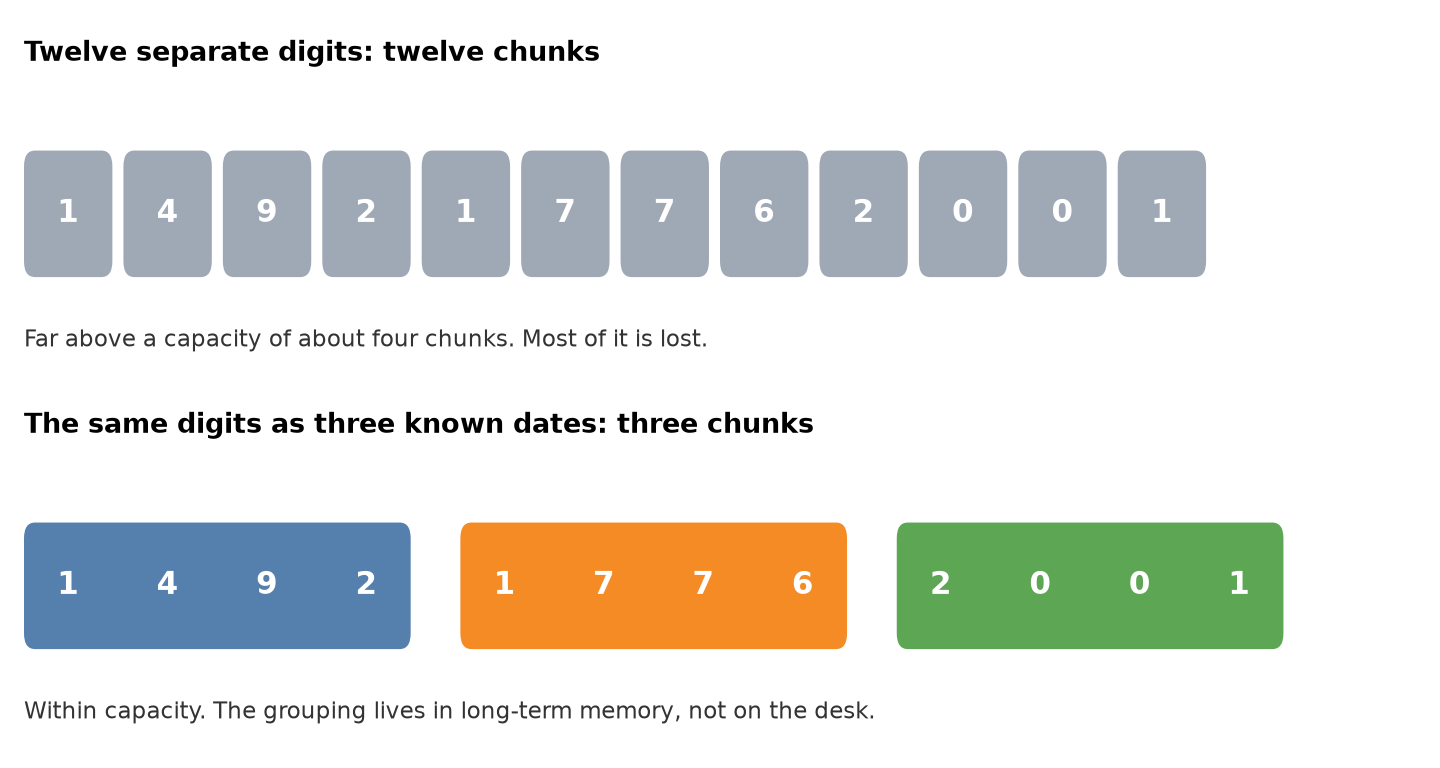 Chunking, drawn for this post. The capacity of about four chunks is Cowan’s estimate; the digit example is illustrative, not experimental data.
For a reader who knows the dates, the second row costs three slots. For one who does not, it costs twelve. This is why expertise looks like a bigger working memory. The desk is the same size. The pieces are larger, and they come from long-term memory.
The cost of leaving something half-done
Switching tasks looks free. Sophie Leroy’s 2009 study shows it is not. Across two experiments she found that people need to stop thinking about one task to fully transition to another, that it is difficult to move attention away from an unfinished task, and that subsequent performance suffers. She called the leftover “attention residue.” Finishing the first task is not enough: she found that time pressure while finishing a prior task was needed to disengage from it.
What this implies is modest and my own reading. If part of the desk is still occupied by the previous task, the next one runs on fewer than four slots.
What can be changed
The practical reading of the three parts is that each fails differently:
- A noisy environment overloads attention.
- Too many open items overflow working memory.
- Unfinished work leaves residue that executive control cannot clear on demand.
None of these is a character flaw. They are limits of a small machine, and the useful response to a limit is a design that does not rely on exceeding it. The next post is about noticing these failures while they happen, since a limit that goes unnoticed cannot be designed around.
Series: How to Think Clearly. 1. Where Thinking Breaks and What to Put There. 2. A Thought Has a Machine Behind It. 3. Catch the Error While It Happens. 4. Make the Right Thing the Easy Thing. 5. The Map Is Not the Territory. 6. Three Tools for Estimating the Unknown. 7. Averages Lie. 8. Price Your Own Hour. 9. Explore Early, Exploit Late, Imagine the Failure First. 10. The Hill You Are Standing On. 11. Let AI Think, Keep the Decision.