Fishing Around Auckland: An Angler's Guide to Saltwater, Freshwater, Boat Fishing, and Spearfishing
A practical guide to fishing around Auckland across saltwater, freshwater, boat fishing, and spearfishing.
Fishing Around Auckland: An Angler’s Guide to Saltwater, Freshwater, Boat Fishing, and Spearfishing
Auckland is one of the easiest cities in New Zealand from which to reach very different kinds of fishing. Within a relatively short drive, an angler can fish the sheltered Waitematā Harbour, cast into the surf on the west coast, explore the Manukau and Kaipara harbours, launch a boat into the Hauraki Gulf, freedive with a speargun, or target trout and coarse fish in freshwater lakes.
There is no single “best” Auckland fishing setup. The right choice depends on the location, target species, tide, wind, swell, season, and fishing method. This guide describes the main options from a practical angler’s perspective.
Fishing rules and protected areas change. The legal limits mentioned here were checked in July 2026, but anglers should always consult the current MPI rules, Fish & Game regulations, local signs, and marine-protection maps before fishing.
1. Popular saltwater fishing areas
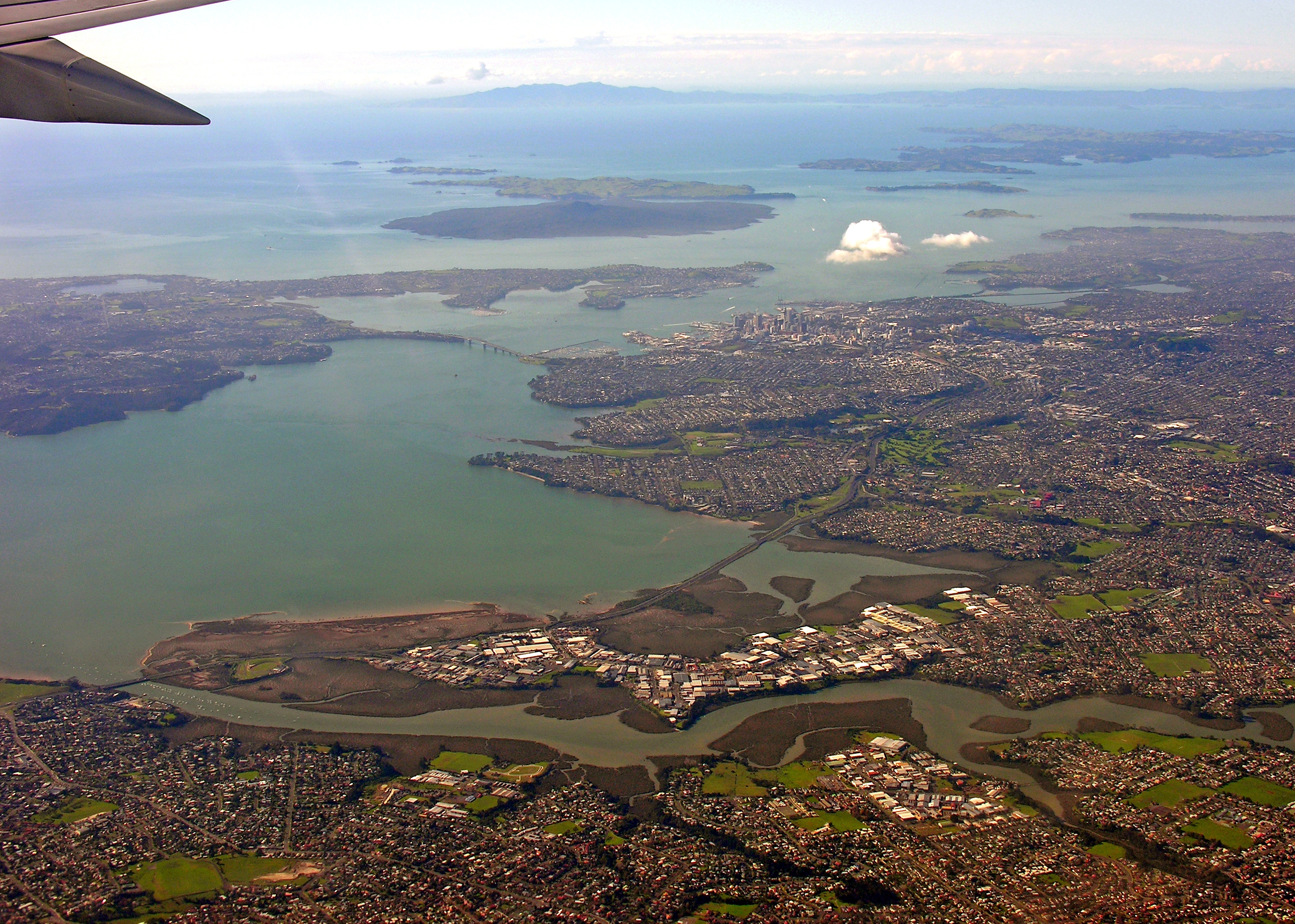 Waitematā Harbour, Auckland. Photo by Phillip Capper, CC BY 2.0, via Wikimedia Commons.
Waitematā Harbour and North Shore wharves
Accessible wharves and harbour edges around the North Shore and inner Waitematā are good places for a short session, especially for beginners and families. Murrays Bay Wharf and similar public wharves can produce fish without requiring specialist equipment.
Common fish
- Snapper
- Kahawai
- Yellow-eyed mullet
- Jack mackerel
- Trevally
- John dory around baitfish schools
- Occasional kingfish during warmer months
Best approach
Use a small ledger rig with squid, pilchard, bonito, or fresh jack mackerel. If kahawai are visibly chasing bait, switch to a 20–40 g metal lure and retrieve it quickly. A live jack mackerel suspended beneath a float can tempt john dory or kingfish, provided live-baiting is permitted and practical at the location.
Fishing is usually better early in the morning, in the evening, or around a high tide. At busy wharves, keep casts controlled and be considerate of pedestrians, swimmers, boats, and other anglers.
Army Bay and the Whangaparāoa Peninsula
The peninsula provides access to beaches, reefs, headlands, and deeper water. It can produce better fish than the inner harbour, but exposed rock platforms require much greater care.
Common fish
- Snapper
- Kahawai
- Trevally
- Kingfish
- John dory
- Squid
Best approach
For snapper, cast an unweighted or lightly weighted pilchard, squid strip, or fresh bait beside reef edges rather than throwing it as far as possible. Soft baits and slow jigs can also work from deeper ledges.
For kahawai and kingfish, keep a metal lure, stickbait, or live-bait rig ready. Squid can be targeted around dawn, dusk, and after dark with size 2.5–3.5 squid jigs.
Parts of the Whangaparāoa coastline are affected by fisheries closures and nearby protected areas. Current maps must be checked before collecting shellfish, seaweed, kina, or other marine life.
East Auckland: Maraetai, Beachlands, and Kawakawa Bay
The eastern side of Auckland provides relatively sheltered fishing in many wind conditions. It is popular for both land-based fishing and small-boat launching.
Common fish
- Snapper
- Kahawai
- Trevally
- John dory
- Flatfish in shallow bays
- Kingfish around structure and bait schools
Best approach
From shore, fish the change of light and the final part of the incoming tide. Snapper often move into surprisingly shallow water after dark. A lightly weighted strayline bait or 4–5 inch soft bait is usually more natural than a heavy sinker in calm water.
From a boat, investigate current lines, channel edges, reef margins, and visible bird activity. Avoid sitting in one place for hours if there is no sign on the sounder and no bites—move and search.
Cornwallis and the Manukau Harbour
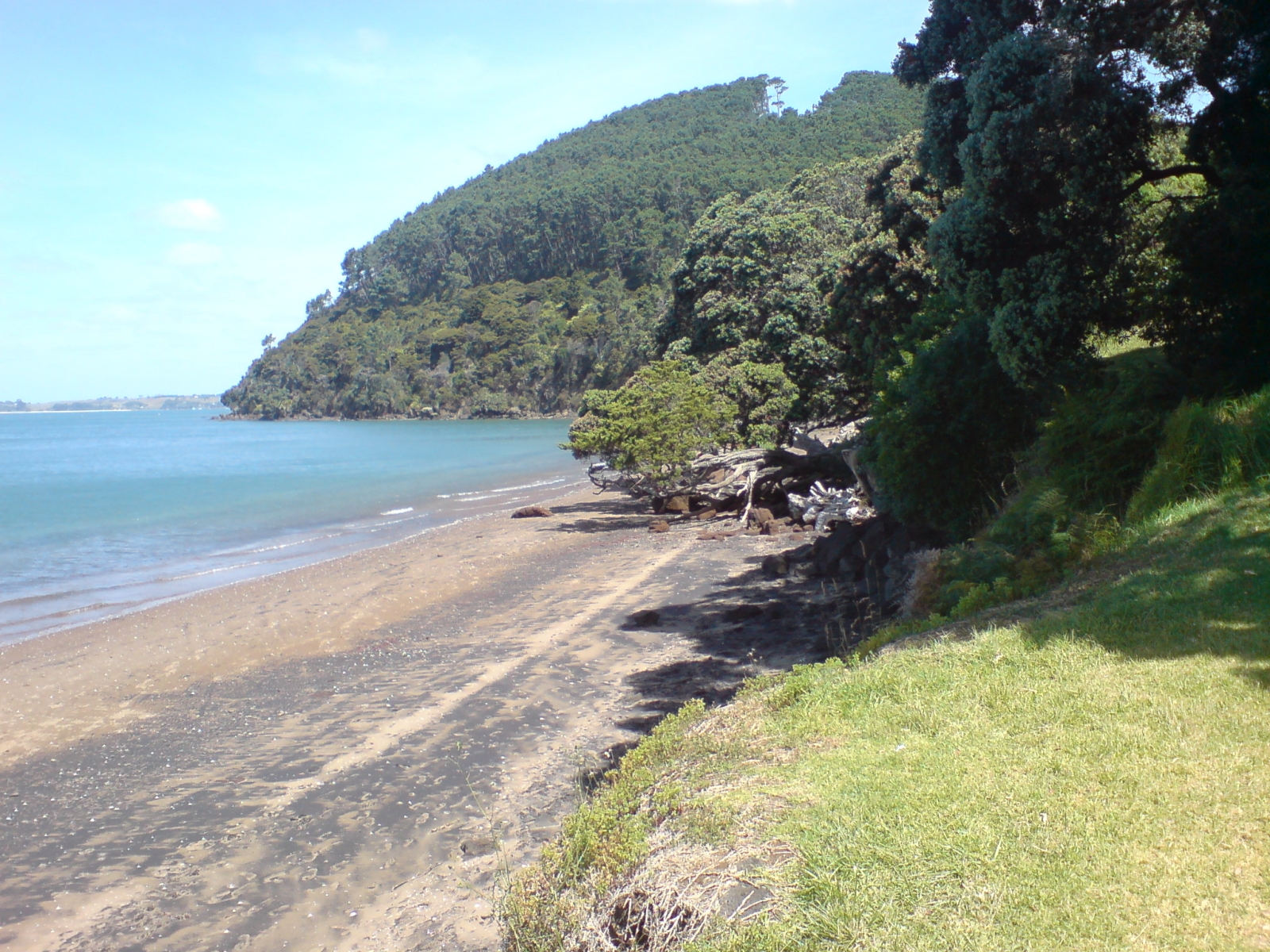 Manukau Harbour near Cornwallis Wharf. Photo by Ingolfson, public domain, via Wikimedia Commons.
Cornwallis Wharf is one of the best-known land-based locations on the Manukau. Other harbour beaches and channels can also fish well, but access, mud, current, and tides need careful planning.
Common fish
- Gurnard
- Kahawai
- Trevally
- Snapper
- Yellow-eyed mullet
- Flounder
- Rig and other sharks
Best approach
A two-hook ledger rig is practical because the Manukau often has strong current. Use enough sinker weight to hold the bottom without making the tackle unnecessarily heavy. Mullet, bonito, pilchard, and squid are reliable baits.
Gurnard respond well to small baits fished close to the seabed. A strip of mullet or bonito on a 3/0–5/0 recurve hook is often sufficient. Adding a small luminous bead can help in dirty water.
The Manukau Bar is exceptionally dangerous. Crossing it is not an ordinary fishing decision and should not be attempted without appropriate training, local knowledge, a suitable vessel, lifejackets, communications, and a current bar report.
Muriwai and the west-coast surf beaches
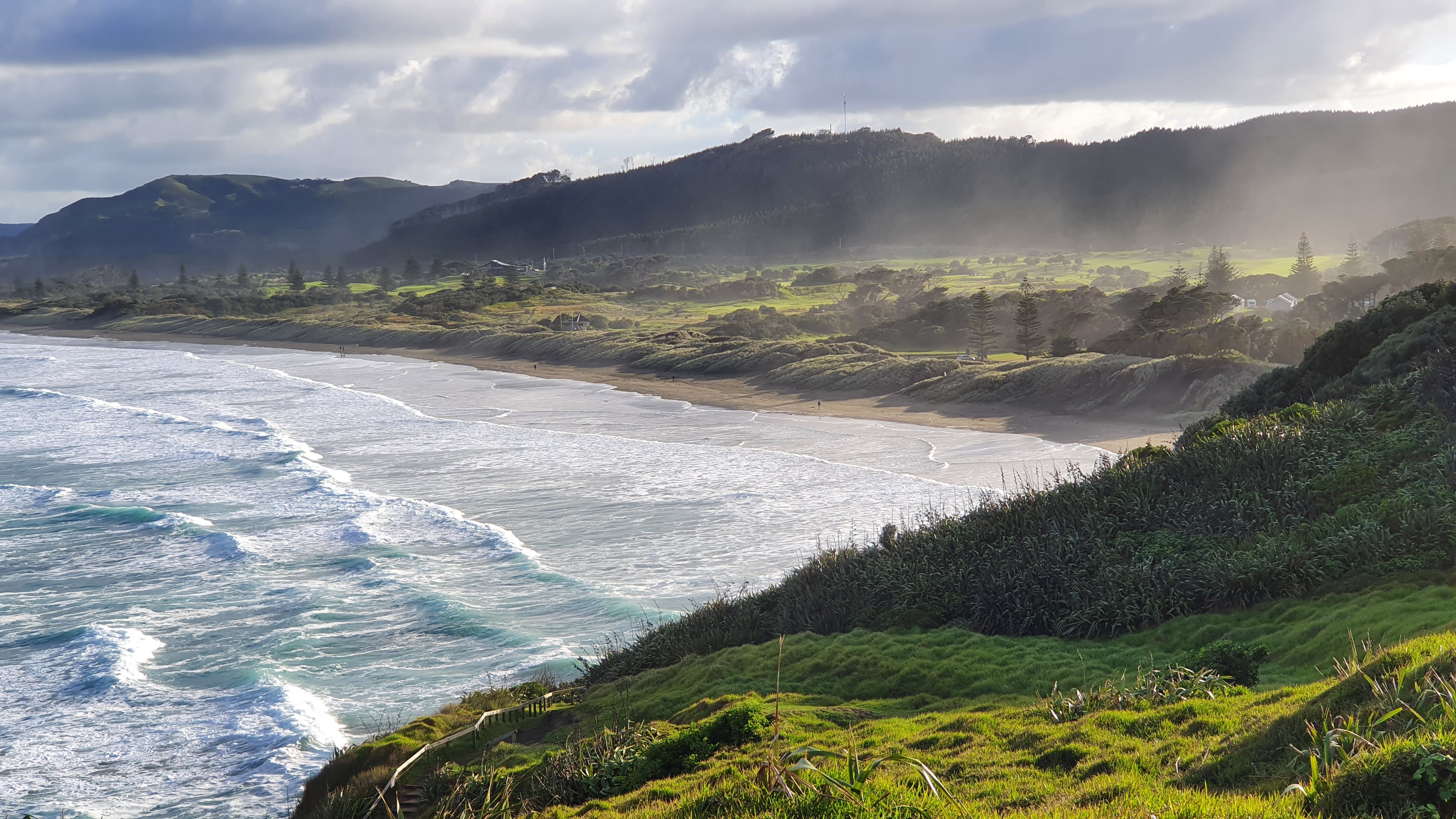 Surf at Muriwai Beach, Auckland’s west coast. Photo by Follash, CC BY-SA 4.0, via Wikimedia Commons.
Auckland’s west coast is powerful and unpredictable, but it can offer excellent surfcasting when the swell is manageable.
Common fish
- Kahawai
- Snapper
- Gurnard
- Trevally
- Rig
- Other sharks
Best approach
Do not automatically make the longest possible cast. Look for gutters, darker water, rips, channel edges, and breaks in the sandbar. Fish often patrol these features close to shore.
Use a breakout sinker and a pulley or clipped-down ledger rig when the surf is strong. Tough baits such as mullet, bonito, squid, and salted bait survive casting better than soft pilchards.
The ideal session has a modest swell, light wind, and a rising tide around dawn or dusk. Large west-coast swells, unstable cliffs, rogue waves, and strong rips can make fishing unsafe even when the weather appears fine. Never turn your back on the sea.
Hauraki Gulf boat fishing
The Rangitoto and Motuihe channels, waters around Rakino, Waiheke, Kawau, and the wider Hauraki Gulf provide Auckland’s most varied boat fishing.
Common fish
- Snapper
- Kahawai
- Kingfish
- Trevally
- John dory
- Gurnard
- Tarakihi in suitable deeper areas
- Jack mackerel and koheru
Best approach
For snapper, drift with soft baits, kabura-style lures, or slow jigs. Match lure weight to depth and current: the lightest lure that regularly reaches the bottom normally looks the most natural.
Watch for:
- Diving gannets and active shearwaters
- Dolphins pushing bait toward the surface
- Bait schools on the sounder
- Current lines and temperature changes
- Reef edges and changes in bottom contour
When fishing a work-up, avoid driving through the feeding activity. Approach from the side, drift across the edge, and leave space for other vessels.
For kingfish, use live jack mackerel or koheru, mechanical jigs, or topwater lures around reef structures and current lines. Kingfish tackle must be substantially stronger than ordinary snapper gear.
Kaipara Harbour
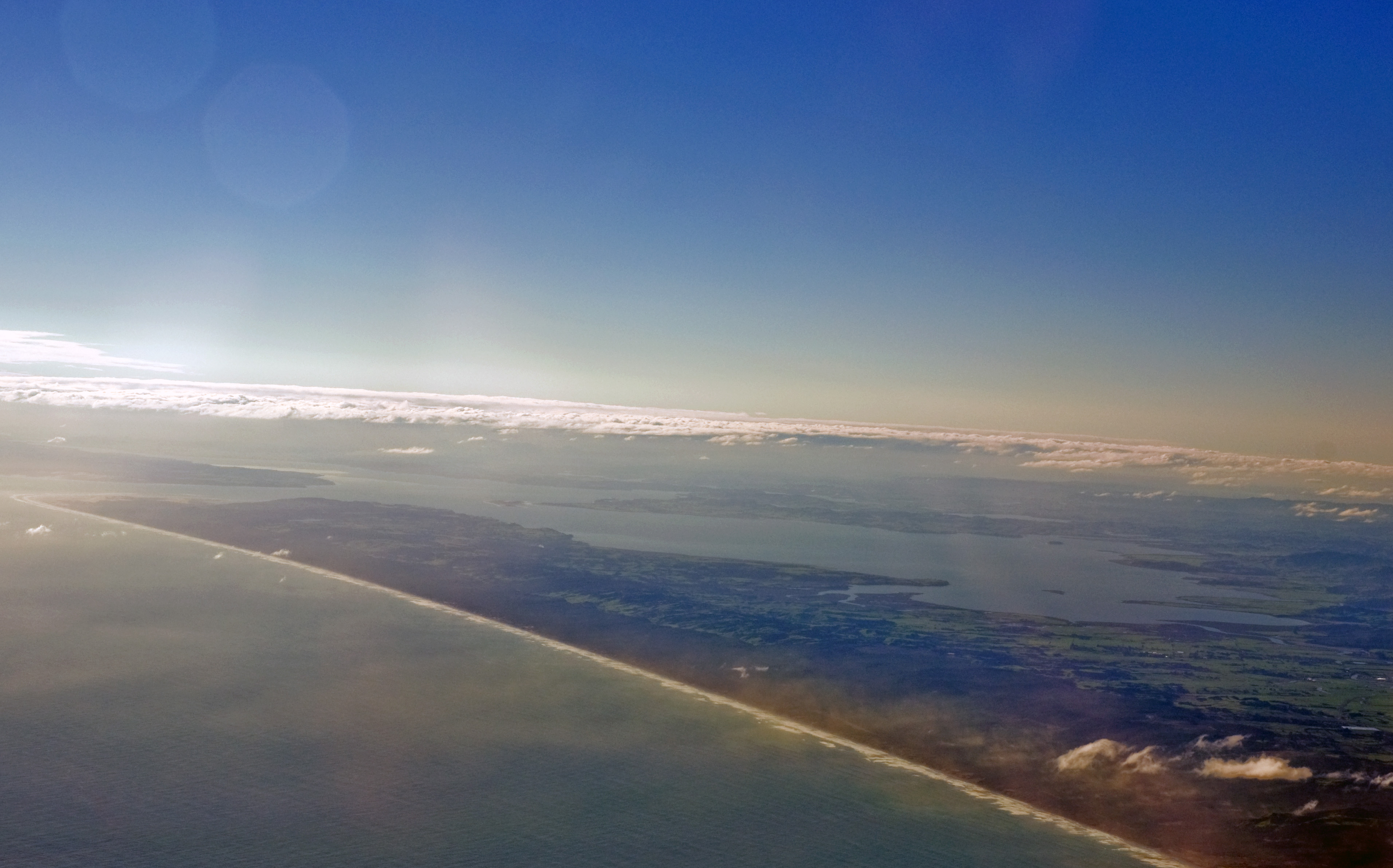 Kaipara Harbour. Photo by Phillip Capper, CC BY 2.0, via Wikimedia Commons.
The Kaipara is enormous, productive, and often difficult to read. Its channels, banks, and shallow flats can hold good numbers of fish, but the current can be powerful.
Common fish
- Snapper
- Gurnard
- Kahawai
- Trevally
- Kingfish
- Rig
- Flatfish
Best approach
Fish channel edges, shell banks, and areas where the depth changes sharply. Bait fishing with a ledger rig is dependable, while soft baits and slow jigs work when the current allows a controlled drift.
As with the Manukau, the Kaipara entrance is a dangerous bar. Harbour fishing does not require crossing it, and inexperienced skippers should remain well inside safe waters.
2. A practical saltwater gear guide
General-purpose wharf and beach setup
- Rod: 7–9 ft, rated approximately 6–10 kg
- Reel: 4000–5000 spinning reel
- Main line: 15–20 lb braid
- Leader: 20–40 lb fluorocarbon or abrasion-resistant nylon
- Hooks: 1/0–5/0 recurve or circle hooks
- Sinkers: 1–4 oz ball, bean, or pyramid sinkers
- Lures: 20–40 g metal lures and 4–5 inch soft baits
This is the most versatile Auckland setup. It is light enough for kahawai and average snapper but still capable of handling an occasional larger fish.
Surfcasting setup
- Rod: 12–14 ft surf rod
- Reel: 6000–10000 long-cast spinning reel
- Main line: 20–30 lb braid, or suitable monofilament
- Shock leader: 40–60 lb
- Sinkers: 4–6 oz breakout sinkers
- Rigs: Pulley rig, running rig, or clipped-down ledger rig
- Hooks: 3/0–7/0 recurve hooks
A shock leader is important when casting a heavy sinker. Check knots, leader damage, and sinker clips before every power cast.
Rock-fishing setup
- Rod: 8–10 ft, rated approximately 10–15 kg
- Reel: 5000–8000 spinning reel
- Main line: 30–50 lb braid
- Leader: 50–80 lb abrasion-resistant leader
- Terminal tackle: Strong swivels, single hooks, and minimal sinker weight
- Lures: Stickbaits, poppers, metal lures, soft baits, and squid jigs
Rock gear must handle both the fish and contact with sharp reef. However, no equipment compensates for unsafe swell. Wear a correctly fitted personal flotation device and footwear with reliable grip, and fish with another person.
Inshore boat setup for snapper
- Rod: 6 ft 6 in–7 ft soft-bait rod, approximately 4–8 kg
- Reel: 2500–4000 spinning reel
- Main line: 10–20 lb braid
- Leader: 15–30 lb fluorocarbon
- Soft baits: 4–7 inch jerk shads, paddletails, and grub styles
- Jig heads: Approximately 1/4–1 oz, adjusted for depth and current
- Other lures: 20–100 g micro jigs, slow jigs, and kabura-style lures
Carry more than one lure weight. A 30 g lure that works in ten metres of water may never reach the bottom in a fast 30-metre channel.
Kingfish setup
- Rod: Purpose-built jigging, live-bait, or topwater rod
- Reel: Heavy spinning reel in the 8000–14000 class, or an appropriate overhead reel
- Main line: 50–80 lb braid
- Leader: 80–130 lb
- Hooks: Strong live-bait or assist hooks
- Lures: Mechanical jigs, stickbaits, and poppers
- Bait: Live jack mackerel or koheru where legal
A strong drag is useful, but maximum drag is not always the answer. Apply pressure smoothly and check every connection before fishing.
3. What should be in the tackle box?
A compact Auckland saltwater tackle box should contain:
- Recurve or circle hooks in several sizes
- Soft-bait jig heads in light, medium, and heavy weights
- Ball, bean, pyramid, and breakout sinkers
- Swivels, clips, and solid rings
- 20, 30, 50, and 80 lb leader material
- Pre-tied ledger, strayline, and live-bait rigs
- Metal lures in silver, blue, and natural baitfish colours
- Soft baits in natural, brown, pink, and bright colours
- Slow jigs or kabura-style lures
- Squid jigs
- Bait elastic
- Long-nose pliers and side cutters
- Dehooker
- Fish-measuring board
- Small sharp knife
- Spare braid scissors
- Headlamp
- First-aid supplies
- Sunscreen
- A rubbish bag
- A current copy or app version of the fishing rules
Recurve hooks are particularly useful for bait fishing because they tend to lodge in the corner of a fish’s mouth. Do not strike aggressively; allow the line to tighten and lift the rod smoothly.
4. Bait and lure selection
Reliable baits
Pilchard: Excellent scent and universally useful, but soft. Use bait elastic when casting.
Squid: Tough, easy to store, and useful in strong current or when small fish are stealing softer bait.
Bonito or skipjack tuna: Oily and effective for snapper, kahawai, gurnard, and sharks.
Mullet: Tough and particularly useful in the Manukau, Kaipara, and surf.
Fresh jack mackerel: Excellent as cut bait and one of the best live baits for kingfish and john dory.
Reliable lures
Soft baits: Best for actively searching for snapper from a drifting boat or kayak.
Metal lures: Excellent for kahawai and other predators chasing bait on the surface.
Slow jigs and kabura-style lures: Effective for boat fishing when presented close to the bottom.
Stickbaits and poppers: Used for kingfish, especially around surface bait activity and reef structure.
Squid jigs: Productive around wharves, weed edges, and illuminated water during low-light periods.
5. How tides affect Auckland fishing
Tide matters because it changes depth, current, water clarity, bait movement, and access.
Land-based fishing
The last two hours of the incoming tide and the first hour after high tide are a useful starting point for beaches, wharves, and shallow harbour edges. Fish often move closer to shore as the water covers rocks, shellfish beds, and weed.
This is not a universal rule. Some channel edges fish better on an outgoing tide because bait is swept out of the shallows.
Boat fishing
Current is usually more important than the exact height of the tide. Moderate flow helps create feeding activity, but very strong spring-tide current may require excessively heavy tackle.
Near slack water can be useful for:
- Fishing deep reefs
- Presenting a live bait accurately
- Jigging in strong channels
- Diving and spearfishing
- Moving safely between locations
West-coast fishing
Tide predictions alone are not enough. Swell height, swell period, wind direction, and beach shape can make a normally fishable location dangerous.
6. Weather and seasonal timing
Wind
For boat fishing, wind against tide can produce steep, uncomfortable chop. A forecast that looks acceptable in terms of wind speed may still create poor conditions when it opposes the current.
An offshore wind can flatten the water close to shore, but it can also push kayaks, small boats, and inflatable equipment away from land. Calm-looking water is not automatically safe.
Rain
Heavy rain can discolour estuaries and freshwater rivers. In saltwater, some colour may help snapper feed confidently, but excessive freshwater and debris can make fishing difficult. For spearfishing, runoff can destroy visibility for several days.
Season
Spring: Snapper begin moving into the Hauraki Gulf and harbours. Work-ups become more common.
Summer: Good for snapper, kahawai, kingfish, trevally, and evening land-based sessions. Boat traffic is heavy.
Autumn: Often one of the most consistent periods. Water remains warm while fish feed before winter.
Winter: Snapper may be less concentrated in shallow water, but gurnard, kahawai, squid, and deeper-water snapper remain available. Lake Pupuke trout fishing becomes particularly worthwhile.
Dawn and dusk are generally productive throughout the year, especially when they coincide with useful tidal movement.
7. Spearfishing around Auckland
Spearfishing around Auckland is normally done while freediving rather than using scuba. Suitable areas include reef country around parts of Waiheke, Kawau, Ti Point, and other outer-gulf headlands—but only outside marine reserves, high-protection areas, temporary closures, and other restricted zones.
The Hauraki Gulf’s protected-area network expanded significantly in October 2025. Never rely on an old fishing chart or a remembered boundary. Check current coordinates or GPX maps before entering the water.
Common targets
- Snapper
- Kingfish
- Butterfish
- Trevally
- John dory
- Kahawai
- Kina where taking is permitted
Rock lobster must not be speared or punctured. There are also current closures affecting the taking of rock lobster in parts of the Auckland and northern Hauraki Gulf region.
Spearfishing equipment
- Wetsuit suitable for the water temperature
- Mask and low-volume snorkel
- Long freediving fins
- Weight belt with quick-release buckle
- Speargun appropriate to visibility and reef type
- Float, float line, and clearly visible dive flag
- Knife or line cutter
- Gloves
- Fish stringer or catch bag attached to the float, not the diver
- Depth and time watch if properly trained to use one
A 90–110 cm railgun is a versatile starting point for Auckland reef diving. Shorter guns are easier in poor visibility and caves, while longer guns suit clearer open water.
Spearfishing timing and safety
Choose days with:
- Light wind
- Low swell
- Minimal recent rainfall
- Good underwater visibility
- Manageable current
- Boat traffic that can be safely avoided
Slack water can make a difficult reef much easier to dive. Always dive with a competent buddy and use active one-up, one-down supervision. Do not treat another diver somewhere in the same bay as effective buddy coverage.
A speargun should remain unloaded until the diver is in the water and must be unloaded before climbing onto rocks or a vessel.
8. Freshwater fishing around Auckland
Freshwater fishing is more limited than saltwater fishing, but Auckland still has worthwhile opportunities.
Lake Pupuke
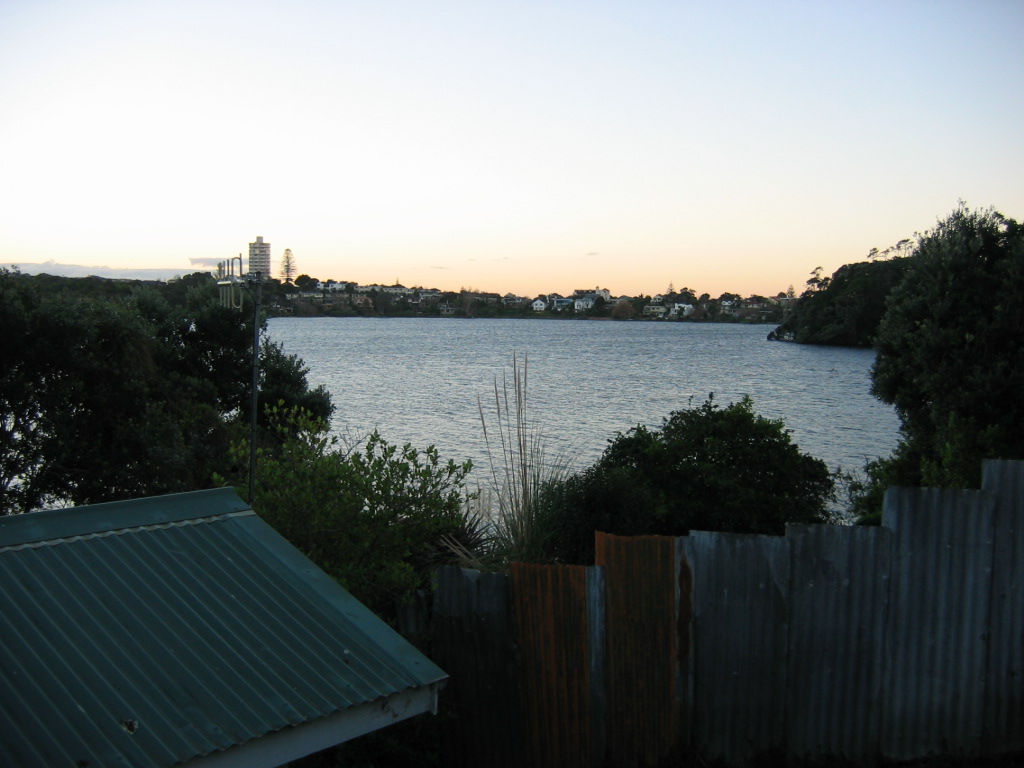 Lake Pupuke at sunset. Photo by Orderinchaos, CC BY-SA 4.0, via Wikimedia Commons.
Lake Pupuke is a mixed fishery in the middle of the North Shore. Fish & Game describes populations of perch, tench, and rudd, together with stocked rainbow and occasional brown trout.
Common fish
- Rainbow trout
- Brown trout
- Perch
- Tench
- Rudd
Best timing
Most trout are caught during the cooler winter months. Perch and coarse fish can be targeted through much of the year, although their activity changes with water temperature.
Recommended gear
- 6–7 ft light spinning rod
- 1000–2500 spinning reel
- 4–8 lb main line
- Small spinners and spoons
- Small soft plastics for perch
- Float or light bottom rig for coarse fish
- 9 ft, 5- or 6-weight fly rod for shore-based trout fishing
Fish & Game notes that fly fishing, spin fishing, and harling can all be successful. Check current rules before using bait or fishing from a boat.
Lake Whatihua and Parkinson’s Lake
These smaller lakes provide stocked-trout opportunities. Fish & Game states that both are normally stocked annually, while summer heat can reduce catch rates in dune lakes.
Common fish
- Rainbow trout
- Coarse fish, depending on the lake
Best timing
Autumn through spring is generally more productive than the hottest part of summer. Fish early or late when the water is cooler and insects are active.
Mangatangi and Mangatawhiri reservoirs
These reservoirs hold wild trout populations. Access and permitted methods can be restricted. For example, Fish & Game identifies artificial-lure restrictions at Mangatangi and limited access around the dam.
Common fish
- Wild rainbow trout
- Occasional brown trout, depending on the water
A 7 ft light spinning rod with small spoons or a 5- to 6-weight fly rod is appropriate, but anglers must verify access and method restrictions before visiting.
Wairoa River near Clevedon
The Wairoa is one of the nearest river-fishing options to Auckland. Fish & Game describes approximately 15 km of fishing water over a wadeable shingle bed.
Common fish
- Rainbow trout
- Brown trout
Fish deeper pools, current seams, undercut banks, and shaded water. A small spinner or a lightly presented nymph is more useful than heavy tackle.
9. Freshwater licences and biosecurity
A current Fish & Game licence is required when fishing for sports fish such as trout, perch, tench, and rudd in the Auckland/Waikato region. The licence must be carried while fishing.
Freshwater rules are not identical everywhere. Waters can have different:
- Open seasons
- Daily limits
- Permitted methods
- Bait restrictions
- Access restrictions
- Boat restrictions
The 2025/2026 Auckland/Waikato regulations allow all-year fishing in many lakes and ponds, but individual waters and methods still need to be checked.
Clean and dry rods, nets, boots, waders, kayaks, and other equipment before moving between waterways. Never transport lake or river water, live bait, or aquatic plants from one waterway to another.
10. Current saltwater rules worth knowing
As checked in July 2026, MPI lists the following Auckland/Kermadec limits:
- A combined daily limit of 20 finfish per fisher, excluding specified baitfish and freshwater eels.
- Individual limits still apply within that combined limit.
- In Auckland East/SNA1, snapper have a daily limit of 7 and a minimum length of 30 cm.
- Auckland West snapper have a daily limit of 10 and a minimum length of 27 cm.
- Kingfish have a daily limit of 3 and a minimum length of 75 cm.
- Trevally have a minimum length of 25 cm.
- Red gurnard have a minimum length of 25 cm.
- Kahawai currently have no listed minimum fish length, but they count toward the combined finfish limit.
These values can change, and special local rules or closures can override general regional limits. The safest practice is to check the NZ Fishing Rules app immediately before every trip.
Marine reserves and high-protection areas are no-take zones. Some other protected areas allow only particular methods or species, so “not a marine reserve” does not necessarily mean unrestricted fishing.
11. A final angler’s checklist
Before leaving home:
- Check the marine or land forecast.
- Check swell height and period, not just wind.
- Check high and low tide times.
- Confirm the fishing area and current legal limits.
- Check marine-reserve and high-protection-area boundaries.
- Confirm land access and parking rules.
- Tell someone where you are going and when you will return.
- Carry lifejackets and two reliable forms of communication when boating.
- Take only what you need and release unwanted fish carefully.
- Bring all fishing line, bait packaging, and rubbish home.
The best Auckland fishing session is not necessarily the one with the largest catch. A safe day, a few fresh fish, good company, and enough local knowledge to improve the next trip are usually a better result.
References and useful links
Ministry for Primary Industries — Auckland and Kermadec fishing rules
Ministry for Primary Industries — NZ Fishing Rules mobile app
Department of Conservation — Hauraki Gulf/Tīkapa Moana marine protected areas
Department of Conservation — Maps, coordinates, and GPX files for Hauraki Gulf protection areas
MarineMate — marine reserves, rules, tides, and boundaries
Fish & Game — Auckland/Waikato 2025/2026 sports-fishing regulations
Fish & Game — Lake Pupuke
Fish & Game — Auckland lakes
Fish & Game — Auckland/Waikato trout-stocking programme
Fish & Game — Buy a freshwater fishing licence
MetService — New Zealand marine forecasts
Toitū Te Whenua Land Information New Zealand — Tide predictions
Maritime New Zealand — Recreational boating safety