How to Think Clearly (4/11): Make the Right Thing the Easy Thing
Defaults, the failed ego-depletion replication, precommitment and if-then plans: why changing friction beats trying harder.
Where this sits: stage 2 of 6, the Setting. The Mind stage found a machine with small limits (posts 2 and 3). If the machine cannot be enlarged, the next lever is the setting it works in, and the cheapest setting to change is friction.
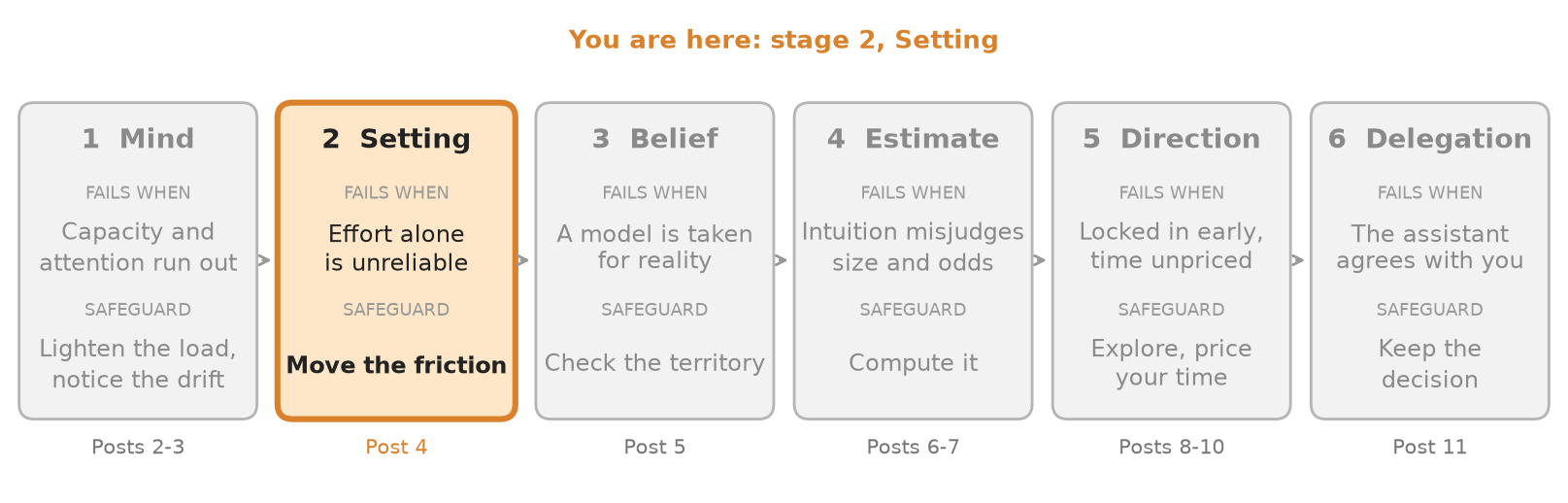 Where this post sits in the series: stage 2 of 6, Setting.
The second post ended on a small machine with small limits: about four chunks of working memory, and attention that leaks from unfinished work. If the machine cannot be enlarged, the remaining lever is the setting it works in. The cheapest setting to change is friction, how much effort each option costs.
A default is a decision made for you
In 2003 Eric Johnson and Daniel Goldstein compared effective organ-donor consent rates across European countries. Where citizens had to opt in, rates were low: 4.25% in Denmark, 12% in Germany, 17.17% in the United Kingdom, 27.5% in the Netherlands. Where citizens had to opt out, they were high: 85.9% in Sweden, 98% in Belgium, 99.98% in Austria.
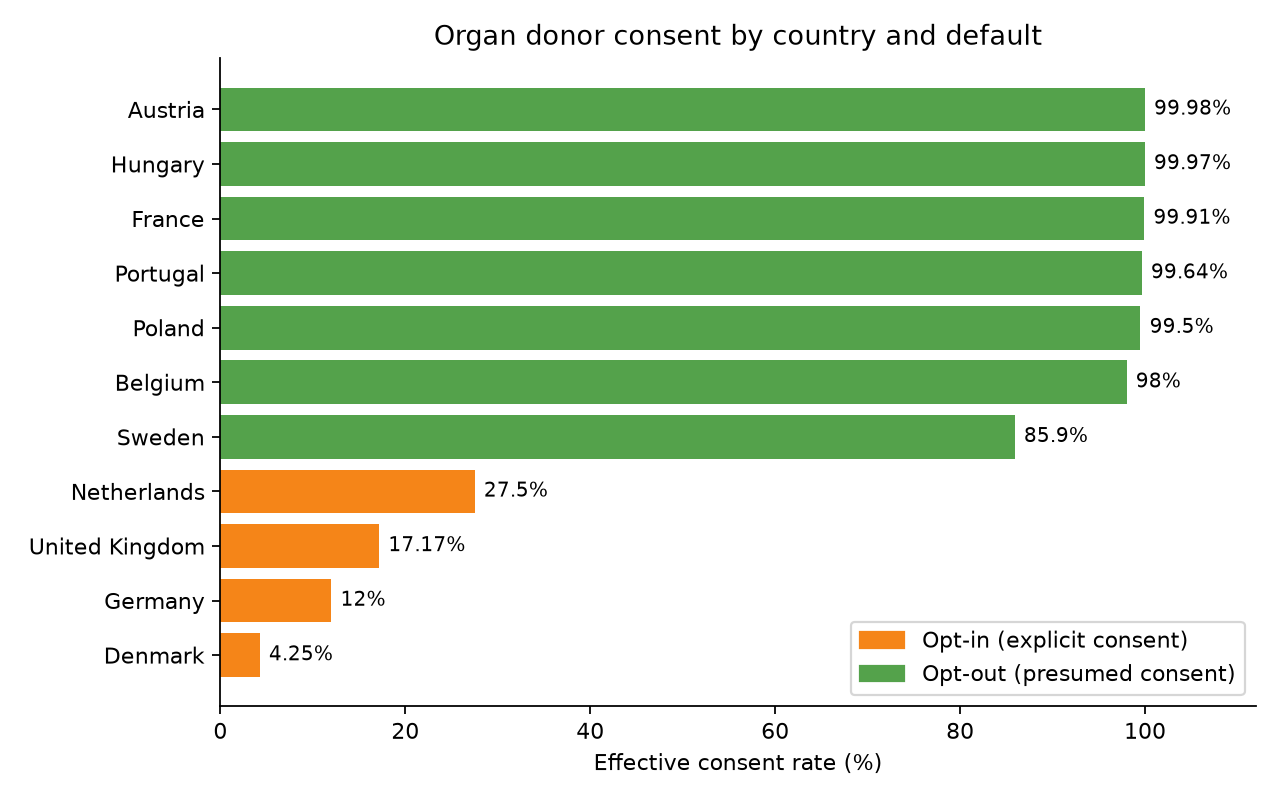 Effective consent rates from Johnson and Goldstein (2003), Science 302:1338. Redrawn for this post.
The figure usually quoted, 12% against 99.8%, compares different countries, so culture, law and health systems differ along with the default. The same paper also reports an online experiment with 161 respondents in which only the default changed: 42% consented under opt-in, 82% under opt-out and 79% with no default. The opt-out result did not differ significantly from the no-default result; only opt-in was significantly lower. Respondents could change their answer with one mouse click, which the authors say largely rules out effort as the explanation. A later review of OECD data adds a caution on the policy side: consent rates are not donation rates, and in many opt-out countries families can still veto.
The claim that survives is narrower and still large. When the preference is weak, the option that costs no effort wins by a wide margin.
Willpower is a poor foundation
If friction decides so much, the obvious fix is to push harder against it. That assumes effort is a resource that runs down with use, the “ego depletion” idea. It has not held up well. A preregistered replication across 23 laboratories and 2,141 participants found an effect of d = 0.04, with a 95% confidence interval of -0.07 to 0.15, which includes zero.
This does not show that self-control is unimportant, and the authors do not claim that. It shows that one popular mechanism for explaining its failure is shaky. The design lesson does not depend on it: relying on moment-to-moment effort is a weak plan whether or not effort drains.
Two ways to move friction
Decide before the moment arrives. In Book 12 of the Odyssey, Circe warns Odysseus about the Sirens. He tells his crew to bind him to the mast and, if he begs to be loosed, to tie him with more bonds. He keeps the experience he wants (hearing the song) and removes the option he will regret (steering toward it). Philosophers call this precommitment.
Replace the decision with a trigger. Peter Gollwitzer’s implementation intentions are if-then plans: if situation Y arises, then I will do Z. In a review by Gollwitzer and Paschal Sheeran of their 2006 meta-analysis, forming such plans had a medium-to-large effect on getting started with a goal (d = .61) compared with holding the goal intention alone. The mechanism fits the Mind stage: a trigger moves the choice out of working memory, which is small, and into the situation, which is not. That link is my reading, not a claim of the paper.
The limit of the idea
Friction design is not neutral. A default is chosen by someone, and a person who never notices the default is steered by it. The honest use is on oneself: set the defaults, bind the mast, write the trigger, and know why. The next post goes one level up, to the maps in the head that tell us which defaults are worth setting.
Series: How to Think Clearly. 1. Where Thinking Breaks and What to Put There. 2. A Thought Has a Machine Behind It. 3. Catch the Error While It Happens. 4. Make the Right Thing the Easy Thing. 5. The Map Is Not the Territory. 6. Three Tools for Estimating the Unknown. 7. Averages Lie. 8. Price Your Own Hour. 9. Explore Early, Exploit Late, Imagine the Failure First. 10. The Hill You Are Standing On. 11. Let AI Think, Keep the Decision.