The iChing Taught Me to Start Before I'm Ready
Lessons from the iChing and Tao Te Ching on uncertainty, change, and starting before certainty arrives.
By Fang Zhang
I almost didn’t write this post.
For weeks, I’ve been studying three ancient Chinese texts — the iChing (易经), the Tao Te Ching (道德经), and Zhuangzi (庄子). The ideas have been quietly reshaping how I think about business, decisions, and life. I wanted to write about them.
But I hesitated.
Will a Western audience care about 3,000-year-old Chinese philosophy? What if I mistranslate the nuance? What if I get it wrong? What if this just… doesn’t land?
And then, mid-conversation with an AI — of all places — I noticed something.
My doubt was the lesson.
变易 — Change Is the Only Constant
The first and most fundamental principle of the iChing is 變易 (biàn yì) — change.
Not change as disruption. Not change as something to manage or survive.
Change as the nature of reality itself.
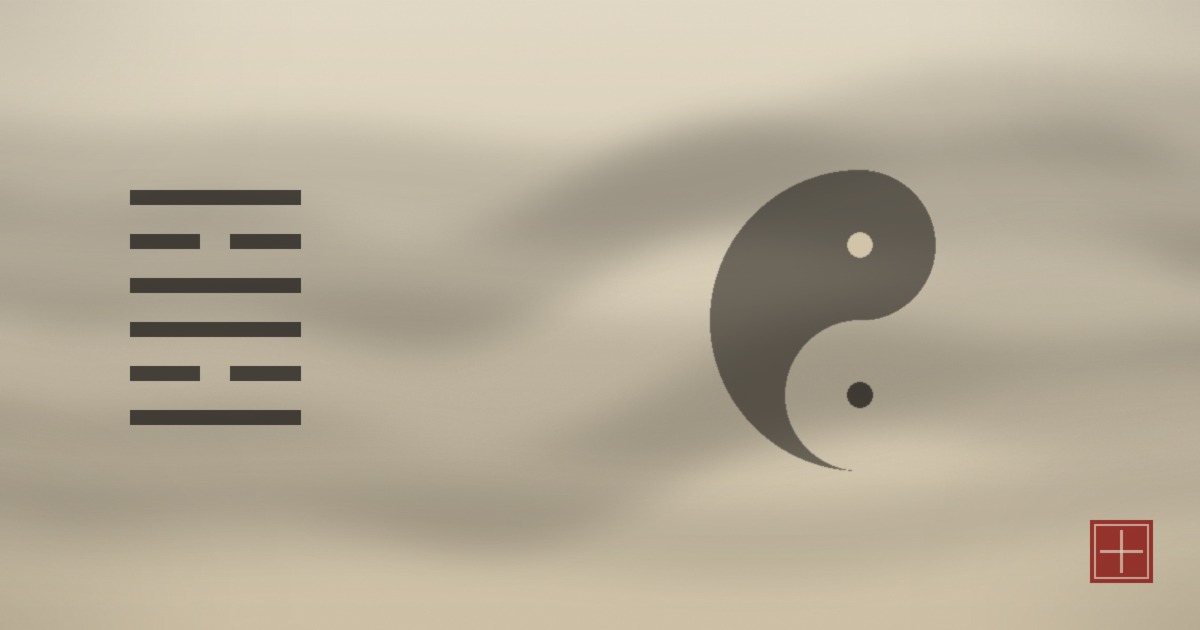
The iChing doesn’t say “things will eventually change.” It says things are always changing — that the appearance of stability is itself a temporary state within a larger movement. The hexagrams (those famous stacked lines) aren’t describing fixed situations. They’re describing moments of transition — where you are in the flow, and what direction the current is moving.
Most of us spend enormous energy trying to find solid ground. A certain plan. A guaranteed outcome. The right moment to begin.
The iChing would call that a misunderstanding of reality.
反者道之動 — The Tao Moves by Reversal
There’s a line in the Tao Te Ching — Chapter 40 — that stopped me completely when I first read it:
反者道之動 (fǎn zhě dào zhī dòng) “Reversal is the movement of the Tao.”
Lao Tzu is pointing at something counterintuitive: the way forward is often found by going into what seems like the opposite direction.
Weakness reveals strength. Emptiness creates usefulness. Uncertainty is where possibility lives.
My hesitation about writing this blog — “I’m not sure this will work” — wasn’t a reason to stop.
It was the signal that something real was beginning.
Because if I already knew it would work, it wouldn’t be a beginning at all. It would just be repetition.
What This Means for Starting Things
I’ve been a founder long enough to know that the projects I felt most certain about at the start were often the ones that taught me the least. And the things I began with doubt — genuinely unsure, genuinely curious — were often the ones that grew into something I couldn’t have planned.
The iChing captures this with the very first hexagram: ☰ Qian (乾) — The Creative.
Its image is Heaven. Pure potential. Pure movement.
The commentary doesn’t say “act when you’re ready.” It says the creative force moves continuously — it doesn’t wait for certainty. It initiates, it transforms, and it persists through whatever arises.
Starting is the preparation.
So Here We Are
This is the first post in a series I’m calling Ancient Signals — my attempt to read the iChing, the Tao Te Ching, and Zhuangzi not as museum pieces, but as living frameworks for navigating a world that changes faster than any plan can keep up with.
I won’t always get the translations perfect. Some nuance will be lost. Some ideas will land differently than I intend.
But that’s the deal with beginning.
变易. Change is constant. 反者道之動. The way forward begins with uncertainty.
Let’s go.
→ If this resonated, subscribe to follow along as I go deeper into these texts — one insight at a time.