How to Think Clearly (8/11): Price Your Own Hour
An hour with no price is spent at zero. Two numbers, one inequality, and the cost that delegation hides.
Where this sits: stage 5 of 6, Direction. The Estimate stage produced numbers for things. Direction starts with the number every plan spends without pricing: the hour. This post gives that hour a price, so that choosing where to point effort has something to compare against.
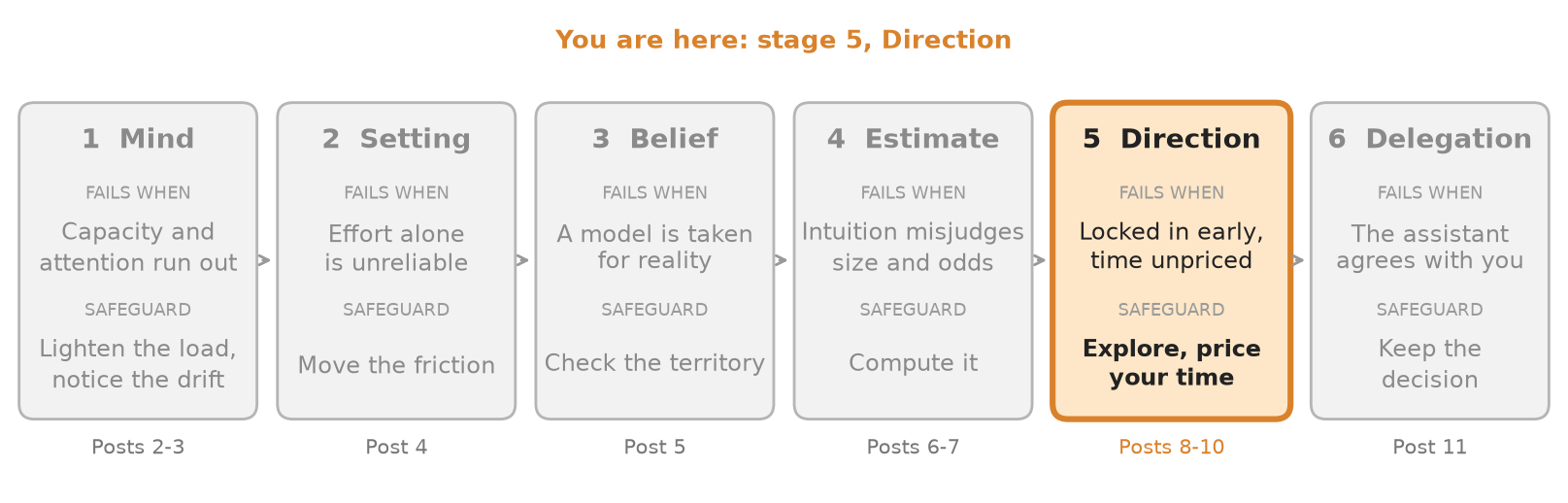 Where this post sits in the series: stage 5 of 6, Direction.
Money arrives with a price tag, and time does not. The post’s argument is that an unpriced hour is spent as if it cost nothing, and there is research on the blind spot behind it. In a 2009 paper on opportunity cost neglect, Shane Frederick and colleagues argue that to weigh the opportunity cost of a purchase, consumers must actively generate the alternatives it would displace, and that they often fail to. Cues that prompt the thought of alternatives reduced purchases, even when people were encouraged to think carefully. A price on the hour is such a cue, built in advance.
Two numbers
Two numbers are enough. The framework is this post’s own.
- Average hourly rate: last year’s income divided by the hours actually worked to earn it, including the evening and weekend work that usually goes uncounted.
- Marginal hourly rate: what one more hour of your best work adds. One more sales call, one more finished piece, one more hour at the thing that pays.
The marginal rate is the one that matters for decisions, because it is the value of what an hour could be exchanged for. A caution: it exists only where an extra hour converts into extra value. For salaried work it may be near zero in money terms, and then the hour’s value sits elsewhere, in rest, learning or family. The principle holds; the unit changes.
One inequality
Whether to hand a task to someone else reduces to one comparison. Let h be the hours the task takes you, r your marginal rate, f the fee, and s the hours you spend briefing, answering questions and checking the result. Hand it over when
h × r > f + s × r
Take a task of 5 hours, a marginal rate of 100, and a fee of 150. Doing it yourself costs 500. Handing it over costs 150 plus one hour of supervision, so 250. If supervision takes two hours, it costs 350, and the saving is still 150. Rearranged, the rule says to hand over whenever supervision stays under h − f/r hours, which here is 3.5.
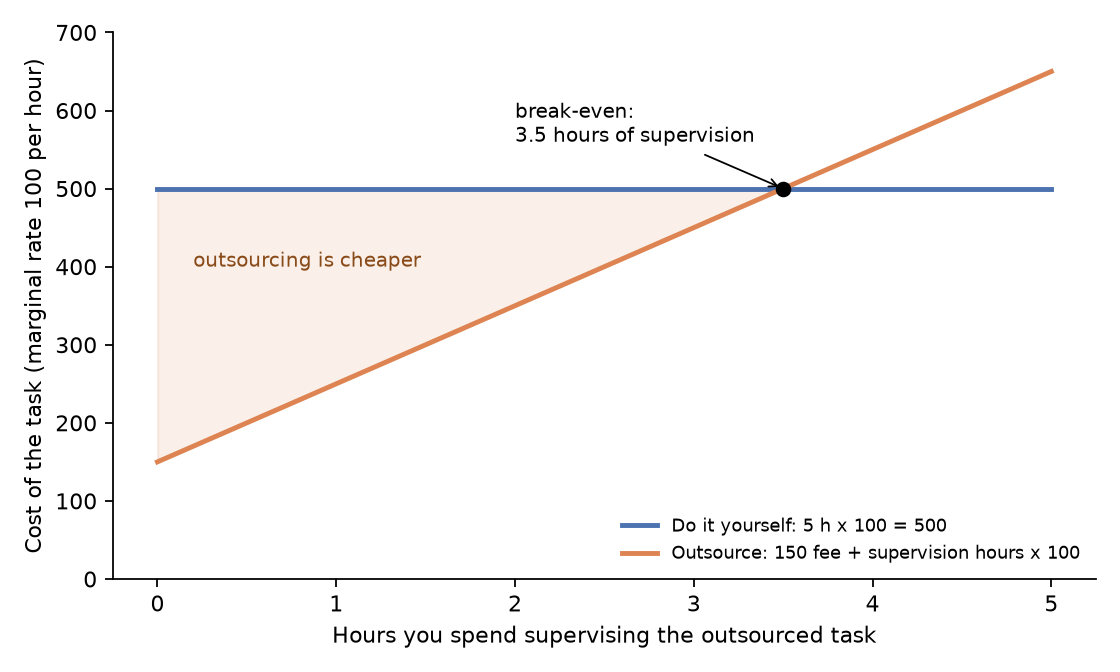 The numbers above, drawn: the outsourced cost rises with supervision, and crosses the do-it-yourself cost at 3.5 hours. Own illustration.
Supervision is the term people leave out. Delegation is not free: the brief has to be written, progress tracked, questions answered, output checked and corrected. An honest estimate of s is what separates a real saving from a task that returns to the desk later and larger.
Where the rule stops
The inequality compares costs. It does not say the freed hour will be worth r. If 150 is paid to avoid five hours of work and the five hours go to scrolling, then 150 was paid for scrolling. The rule works only with a use for the hour that actually earns or restores something. This is the post’s own argument.
It also does not apply to work that is the source of one’s value, such as the part clients or readers actually come for. Those hours are the head of the power-law distribution from the previous post, and the rule is aimed at the tail.
Handing off also adds a link to the chain. In the previous post’s arithmetic, a process succeeds at the product of its steps. If a task you would complete reliably is handed to a step that succeeds 70% of the time, the outcome is capped at 70% unless checking catches the failures, which is the supervision term again.
What the hour buys besides output
The value of a freed hour is not only the work it makes possible. In a 2017 paper in PNAS, Ashley Whillans, Elizabeth Dunn and colleagues used samples from the United States, Canada, Denmark and the Netherlands (n = 6,271) and found that people who spend money on time-saving services report greater life satisfaction. A field experiment found working adults reported greater happiness after spending money on a time-saving purchase than on a material one. Under their account, buying time buffers against time scarcity. So the hour’s price has a second component, relief, which no income figure includes.
The same rule for software
The inequality applies unchanged to AI agents, where f is nearly zero and the entire question falls on s. By this rule, a task should be handed to an agent only if checking its output takes clearly less time than doing the task. If verification takes as long as the work, the agent only adds a step. That is an application of the rule above, not a measured result.
A price on the hour is a tool for choosing, not a measure of worth. Used as the first, it changes what gets chosen: the work that only you can do gets the hours, and the rest gets weighed against them. The next post turns to what those hours should be pointed at: when to search, and when to commit.
Series: How to Think Clearly. 1. Where Thinking Breaks and What to Put There. 2. A Thought Has a Machine Behind It. 3. Catch the Error While It Happens. 4. Make the Right Thing the Easy Thing. 5. The Map Is Not the Territory. 6. Three Tools for Estimating the Unknown. 7. Averages Lie. 8. Price Your Own Hour. 9. Explore Early, Exploit Late, Imagine the Failure First. 10. The Hill You Are Standing On. 11. Let AI Think, Keep the Decision.